< ARCHIVE

> FILE / 9FCE4C9A

AIR-INTEL-MEMO-4, REPORTING PROCEDURES, UNCONVENTIONAL AIRCRAFT, FEBRUARY 1949

This document establishes the official Air Force reporting procedures for sightings of unconventional aircraft and unidentified flying objects. It provides detailed instructions for the use of AF Form 112, including technical questionnaires for observers, radar data requirements, and investigative protocols for physical evidence and radioactivity testing.

AGENCY
AIR FORCE
TYPE
REPORT
INCIDENT DATE
N/A
LOCATION
N/A
PAGES
137
EXTRACTED
127 / 137
STATUS
READY

> PAGES INDEXED [137]

OPEN A PAGE BELOW

  1. Page 1P.1UNCLASSI
  2. Page 2P.2
  3. Page 3P.3
  4. Page 4P.4UNCLASSI
  5. Page 5P.5UNCLASSI
  6. Page 6P.6
  7. Page 7P.7UNCLASSI
  8. Page 8P.8SECRET
  9. Page 9P.9
  10. Page 10P.10
  11. Page 11P.11UNCLASSI
  12. Page 12P.12UNCLASSI
  13. Page 13P.13
  14. Page 14P.14UNCLASSI
  15. Page 15P.15
  16. Page 16P.16
  17. [NO PREVIEW]
    P.17
  18. Page 18P.18UNCLASSI
  19. Page 19P.19
  20. Page 20P.20
  21. Page 21P.21
  22. Page 22P.22
  23. Page 23P.23
  24. Page 24P.24
  25. Page 25P.25
  26. Page 26P.26UNCLASSI
  27. Page 27P.27
  28. Page 28P.28
  29. Page 29P.29
  30. Page 30P.30
  31. Page 31P.31UNCLASSI
  32. Page 32P.32
  33. [NO PREVIEW]
    P.33
  34. Page 34P.34UNCLASSI
  35. Page 35P.35
  36. Page 36P.36UNCLASSI
  37. Page 37P.37
  38. Page 38P.38UNCLASSI
  39. Page 39P.39UNCLASSI
  40. Page 40P.40UNCLASSI
  41. Page 41P.41
  42. Page 42P.42
  43. Page 43P.43
  44. Page 44P.44UNCLASSI
  45. Page 45P.45
  46. Page 46P.46UNCLASSI
  47. Page 47P.47UNCLASSI
  48. Page 48P.48
  49. [NO PREVIEW]
    P.49
  50. Page 50P.50
  51. Page 51P.51UNCLASSI
  52. Page 52P.52UNCLASSI
  53. Page 53P.53
  54. Page 54P.54
  55. Page 55P.55UNCLASSI
  56. Page 56P.56
  57. [NO PREVIEW]
    P.57
  58. Page 58P.58
  59. Page 59P.59
  60. Page 60P.60
  61. Page 61P.61
  62. Page 62P.62UNCLASSI
  63. Page 63P.63UNCLASSI
  64. Page 64P.64SECRET
  65. [NO PREVIEW]
    P.65
  66. Page 66P.66
  67. Page 67P.67
  68. Page 68P.68
  69. Page 69P.69UNCLASSI
  70. Page 70P.70
  71. Page 71P.71UNCLASSI
  72. Page 72P.72
  73. Page 73P.73
  74. Page 74P.74
  75. Page 75P.75
  76. Page 76P.76UNCLASSI
  77. Page 77P.77
  78. Page 78P.78
  79. Page 79P.79UNCLASSI
  80. Page 80P.80UNCLASSI
  81. Page 81P.81
  82. Page 82P.82UNCLASSI
  83. Page 83P.83UNCLASSI
  84. Page 84P.84UNCLASSI
  85. Page 85P.85UNCLASSI
  86. Page 86P.86
  87. Page 87P.87SECRET
  88. Page 88P.88
  89. [NO PREVIEW]
    P.89
  90. Page 90P.90UNCLASSI
  91. Page 91P.91
  92. Page 92P.92UNCLASSI
  93. Page 93P.93UNCLASSI
  94. Page 94P.94
  95. Page 95P.95
  96. Page 96P.96
  97. Page 97P.97
  98. Page 98P.98UNCLASSI
  99. Page 99P.99UNCLASSI
  100. Page 100P.100UNCLASSI
  101. Page 101P.101
  102. Page 102P.102UNCLASSI
  103. Page 103P.103UNCLASSI
  104. Page 104P.104SECRET
  105. [NO PREVIEW]
    P.105
  106. Page 106P.106UNCLASSI
  107. Page 107P.107UNCLASSI
  108. Page 108P.108UNCLASSI
  109. Page 109P.109
  110. Page 110P.110
  111. Page 111P.111
  112. Page 112P.112UNCLASSI
  113. [NO PREVIEW]
    P.113
  114. Page 114P.114UNCLASSI
  115. Page 115P.115
  116. Page 116P.116
  117. Page 117P.117
  118. Page 118P.118
  119. Page 119P.119
  120. Page 120P.120
  121. [NO PREVIEW]
    P.121
  122. Page 122P.122UNCLASSI
  123. Page 123P.123
  124. Page 124P.124UNCLASSI
  125. Page 125P.125
  126. Page 126P.126
  127. Page 127P.127UNCLASSI
  128. Page 128P.128
  129. [NO PREVIEW]
    P.129
  130. Page 130P.130UNCLASSI
  131. Page 131P.131UNCLASSI
  132. Page 132P.132
  133. Page 133P.133
  134. Page 134P.134
  135. Page 135P.135
  136. Page 136P.136
  137. Page 137P.137

> PAGE TEXT

PAGE 1

cover-page

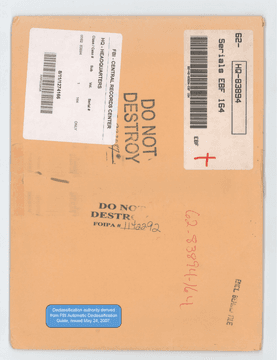
This is a cover page for an FBI file, marked with case number 62-HQ-83894 and serial 164, including instructions not to destroy the document.

62- HQ-83894
Serials EBF 164

[HANDWRITTEN: +]

FBI - CENTRAL RECORDS CENTER

HQ - HEADQUARTERS
Class / Case # Sub Vol. Serial #
0062 83894 1 164 ONLY

DO NOT DESTROY
[HANDWRITTEN: 202087]

DO NOT DESTROY
FOIPA # 1142292

[HANDWRITTEN: 62-83894-164]

[HANDWRITTEN: ENCL BEHIND FILE]

Declassification authority derived from FBI Automatic Declassification Guide, issued May 24, 2007.

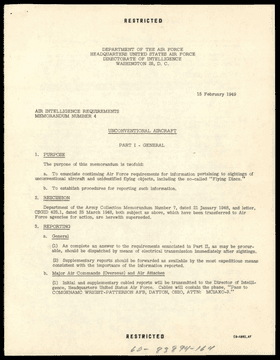
PAGE 2

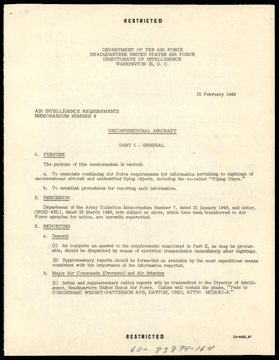
memo

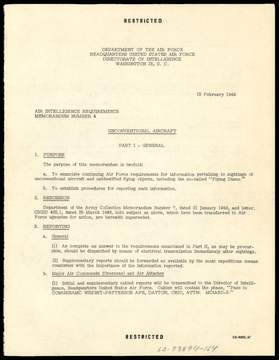
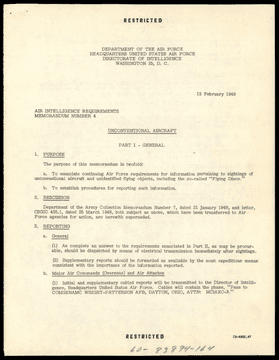
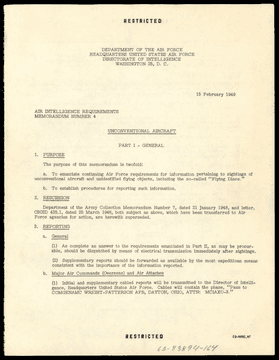
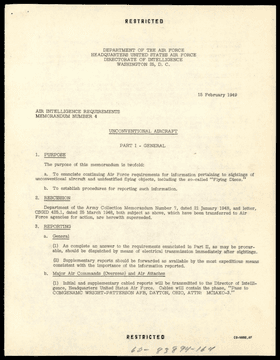
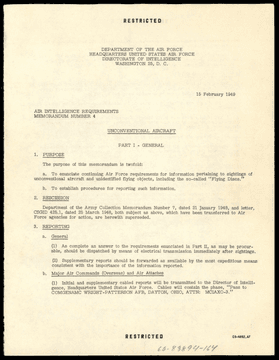
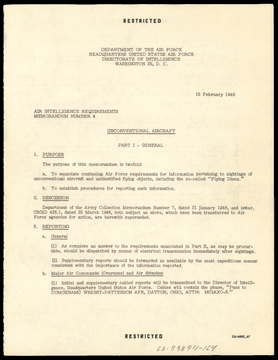
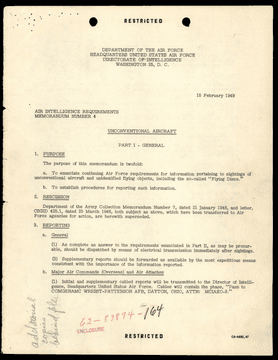
This memorandum from the Department of the Air Force, dated February 15, 1949, outlines requirements and reporting procedures for sightings of unconventional aircraft and unidentified flying objects.

RESTRICTED

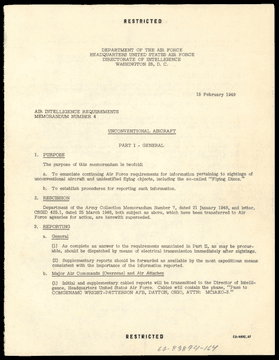
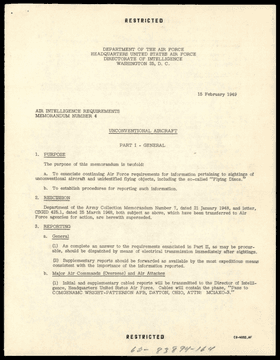
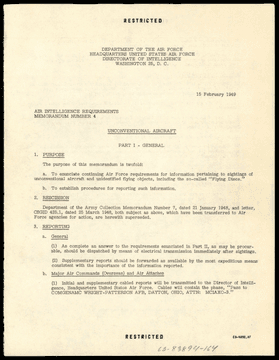
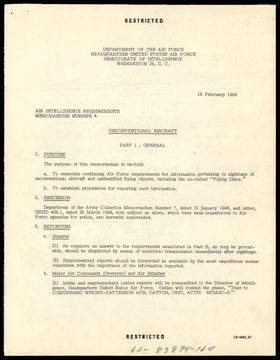
DEPARTMENT OF THE AIR FORCE
HEADQUARTERS UNITED STATES AIR FORCE
DIRECTORATE OF INTELLIGENCE
WASHINGTON 25, D. C.

15 February 1949

AIR INTELLIGENCE REQUIREMENTS
MEMORANDUM NUMBER 4

UNCONVENTIONAL AIRCRAFT

PART I - GENERAL

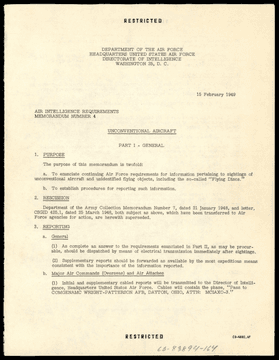
1. PURPOSE

The purpose of this memorandum is twofold:

a. To enunciate continuing Air Force requirements for information pertaining to sightings of unconventional aircraft and unidentified flying objects, including the so-called "Flying Discs."

b. To establish procedures for reporting such information.

2. RESCISSION

Department of the Army Collection Memorandum Number 7, dated 21 January 1948, and letter, CSGID 425.1, dated 25 March 1948, both subject as above, which have been transferred to Air Force agencies for action, are herewith superseded.

3. REPORTING

a. General

(1) As complete an answer to the requirements enunciated in Part II, as may be procurable, should be dispatched by means of electrical transmission immediately after sightings.

(2) Supplementary reports should be forwarded as available by the most expeditious means consistent with the importance of the information reported.

b. Major Air Commands (Overseas) and Air Attaches

(1) Initial and supplementary cabled reports will be transmitted to the Director of Intelligence, Headquarters United States Air Force. Cables will contain the phase, "Pass to COMGENAMC WRIGHT-PATTERSON AFB, DAYTON, OHIO, ATTN: MCIAXO-3."

[HANDWRITTEN: additional copies behind file]

62-83894-164

ENCLOSURE

RESTRICTED
C9-4892, AF

PAGE 3

memo

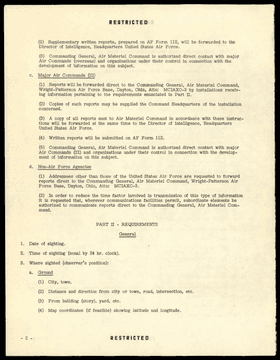
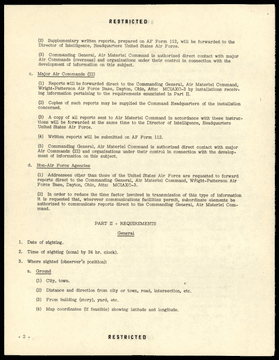
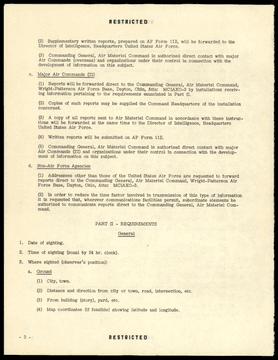
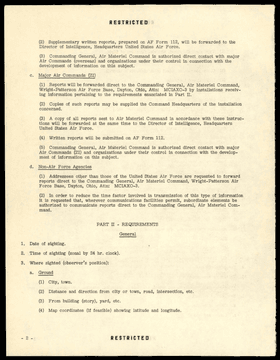
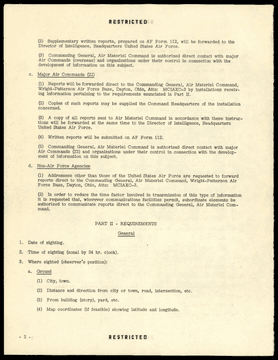
This page outlines reporting procedures for UAP sightings, specifying that reports should be submitted on AF Form 112 to the Air Materiel Command at Wright-Patterson Air Force Base, and lists the required information for such reports.

RESTRICTED

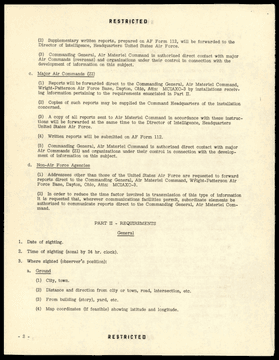
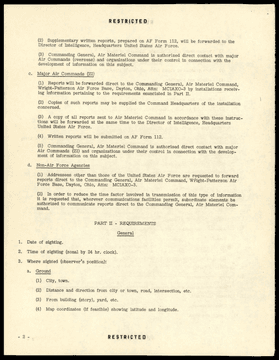
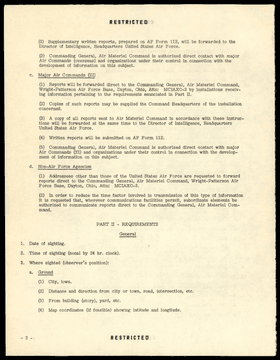
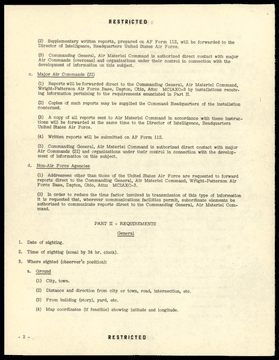
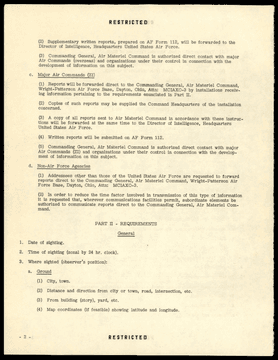
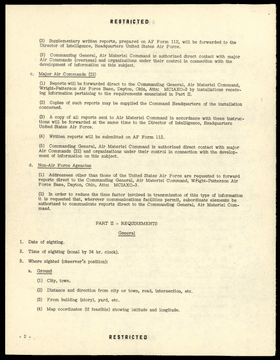
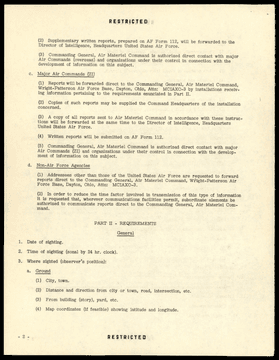
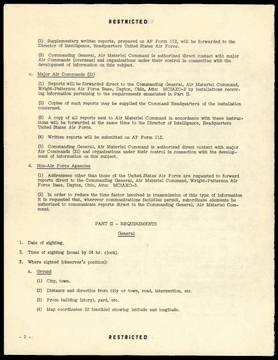
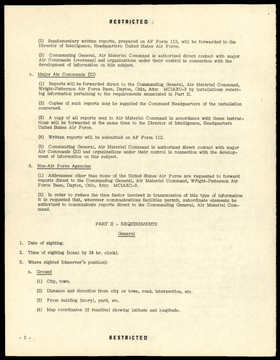
(2) Supplementary written reports, prepared on AF Form 112, will be forwarded to the
Director of Intelligence, Headquarters United States Air Force.

(3) Commanding General, Air Materiel Command is authorized direct contact with major
Air Commands (overseas) and organizations under their control in connection with the
development of information on this subject.

c. Major Air Commands (ZI)

(1) Reports will be forwarded direct to the Commanding General, Air Materiel Command,
Wright-Patterson Air Force Base, Dayton, Ohio, Attn: MCIAXO-3 by installations receiv-
ing information pertaining to the requirements enunciated in Part II.

(2) Copies of such reports may be supplied the Command Headquarters of the installation
concerned.

(3) A copy of all reports sent to Air Materiel Command in accordance with these instruc-
tions will be forwarded at the same time to the Director of Intelligence, Headquarters
United States Air Force.

(4) Written reports will be submitted on AF Form 112.

(5) Commanding General, Air Materiel Command is authorized direct contact with major
Air Commands (ZI) and organizations under their control in connection with the develop-
ment of information on this subject.

d. Non-Air Force Agencies

(1) Addressees other than those of the United States Air Force are requested to forward
reports direct to the Commanding General, Air Materiel Command, Wright-Patterson Air
Force Base, Dayton, Ohio, Attn: MCIAXO-3.

(2) In order to reduce the time factor involved in transmission of this type of information
it is requested that, wherever communications facilities permit, subordinate elements be
authorized to communicate reports direct to the Commanding General, Air Materiel Com-
mand.

PART II - REQUIREMENTS

General

1. Date of sighting.

2. Time of sighting (zonal by 24 hr. clock).

3. Where sighted (observer's position):

a. Ground

(1) City, town.

(2) Distance and direction from city or town, road, intersection, etc.

(3) From building (story), yard, etc.

(4) Map coordinates (if feasible) showing latitude and longitude.

- 2 - RESTRICTED

PAGE 4

form

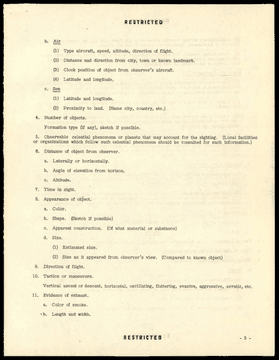
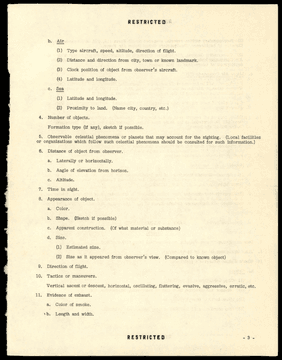
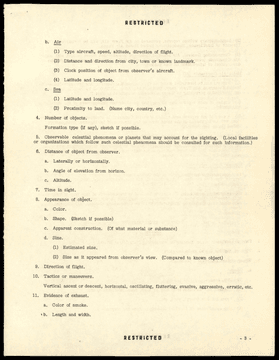
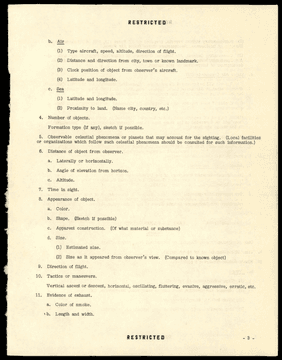
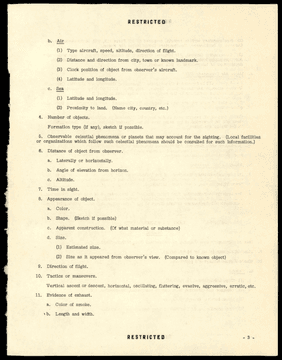
This page is a continuation of a reporting form for unidentified aerial phenomena, listing specific data points to be recorded regarding sightings, such as object appearance, maneuvers, and environmental context.

RESTRICTED

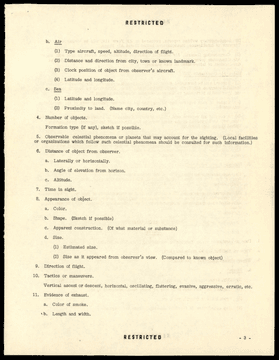
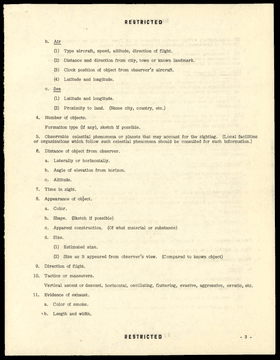
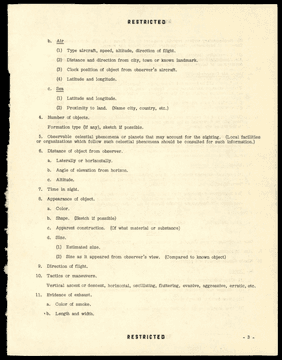
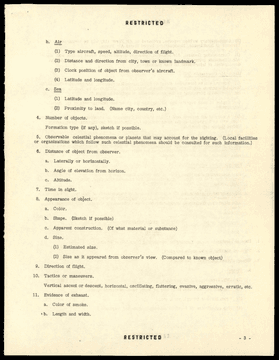
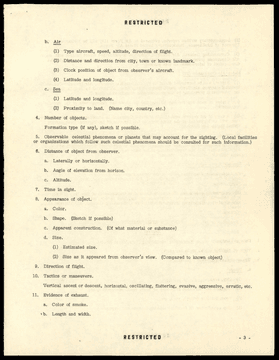
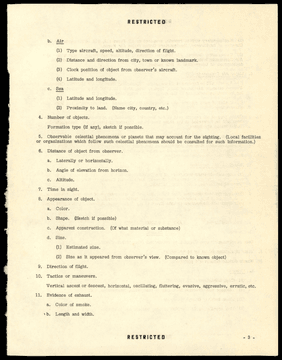
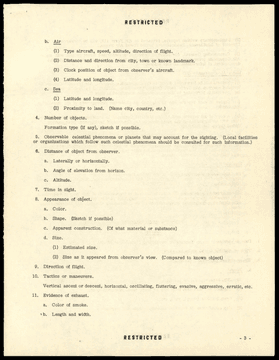
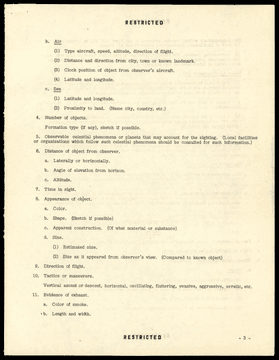
b. Air
(1) Type aircraft, speed, altitude, direction of flight.
(2) Distance and direction from city, town or known landmark.
(3) Clock position of object from observer's aircraft.
(4) Latitude and longitude.
c. Sea
(1) Latitude and longitude.
(2) Proximity to land. (Name city, country, etc.)
4. Number of objects.
Formation type (if any), sketch if possible.
5. Observable celestial phenomena or planets that may account for the sighting. (Local facilities or organizations which follow such celestial phenomena should be consulted for such information.)
6. Distance of object from observer.
a. Laterally or horizontally.
b. Angle of elevation from horizon.
c. Altitude.
7. Time in sight.
8. Appearance of object.
a. Color.
b. Shape. (Sketch if possible)
c. Apparent construction. (Of what material or substance)
d. Size.
(1) Estimated size.
(2) Size as it appeared from observer's view. (Compared to known object)
9. Direction of flight.
10. Tactics or maneuvers.
Vertical ascent or descent, horizontal, oscillating, fluttering, evasive, aggressive, erratic, etc.
11. Evidence of exhaust.
a. Color of smoke.
b. Length and width.

RESTRICTED
- 3 -

PAGE 5

form

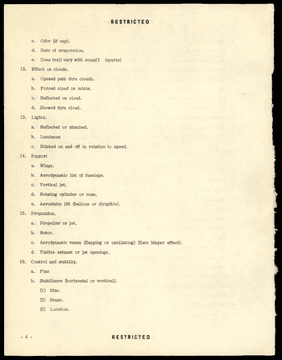
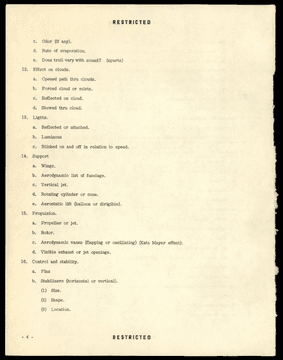
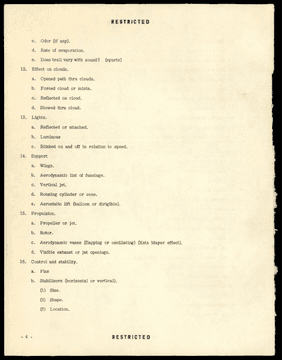
This page is a continuation of a questionnaire or checklist used for reporting unidentified aerial phenomena, specifically detailing categories for cloud effects, lights, support mechanisms, propulsion, and control/stability.

RESTRICTED

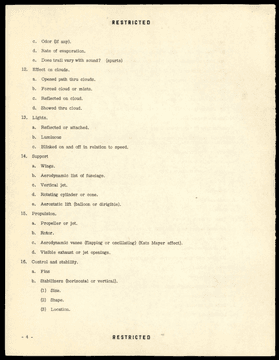
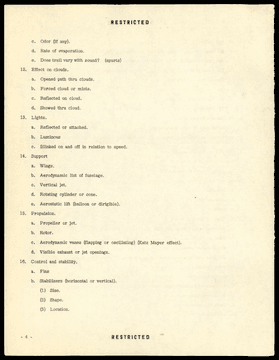
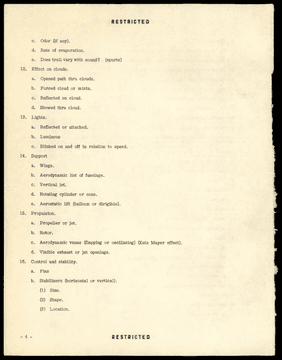
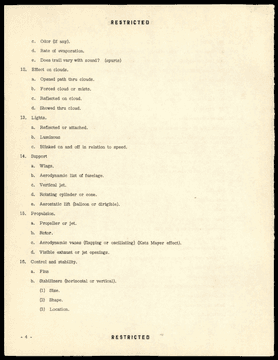
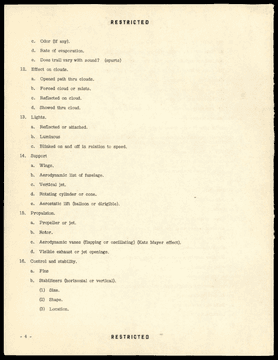
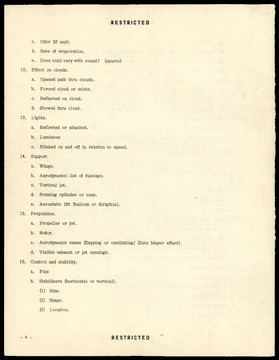
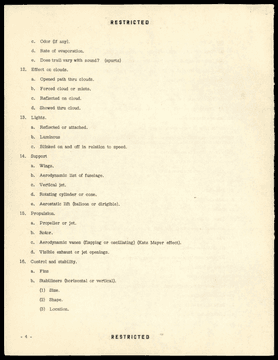
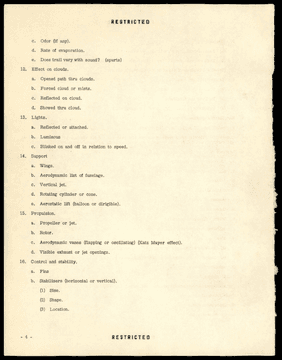
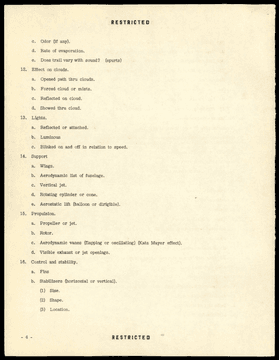
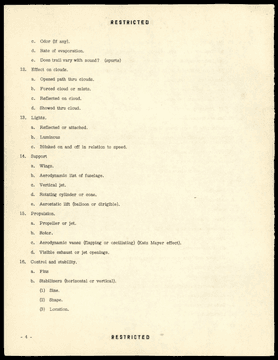
c. Odor (if any).
d. Rate of evaporation.
e. Does trail vary with sound? (spurts)
12. Effect on clouds.
a. Opened path thru clouds.
b. Forced cloud or mists.
c. Reflected on cloud.
d. Showed thru cloud.
13. Lights.
a. Reflected or attached.
b. Luminous
c. Blinked on and off in relation to speed.
14. Support
a. Wings.
b. Aerodynamic list of fuselage.
c. Vertical jet.
d. Rotating cylinder or cone.
e. Aerostatic lift (balloon or dirigible).
15. Propulsion.
a. Propeller or jet.
b. Rotor.
c. Aerodynamic vanes (flapping or oscillating) (Katz Mayer effect).
d. Visible exhaust or jet openings.
16. Control and stability.
a. Fins
b. Stabilizers (horizontal or vertical).
(1) Size.
(2) Shape.
(3) Location.
- 4 - RESTRICTED

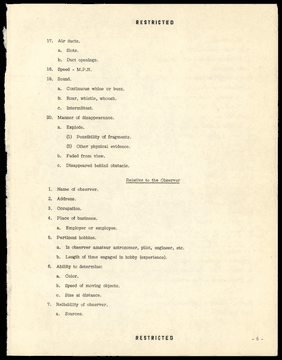
PAGE 6

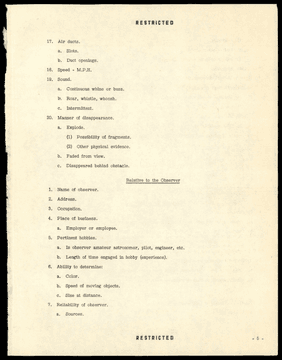
form

This page is a continuation of a questionnaire or reporting form, listing criteria for describing UAP characteristics (air ducts, speed, sound, disappearance) and observer information (name, address, occupation, hobbies, reliability).

RESTRICTED

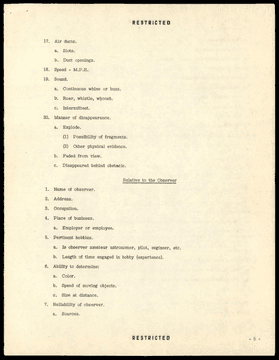
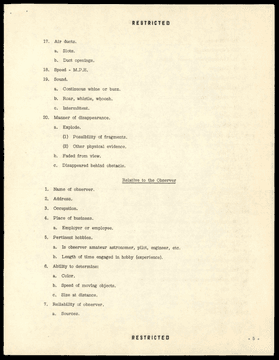
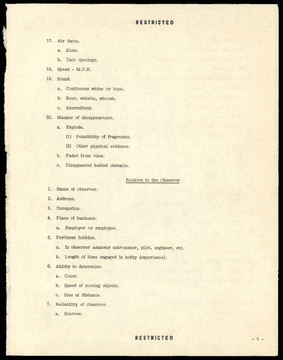
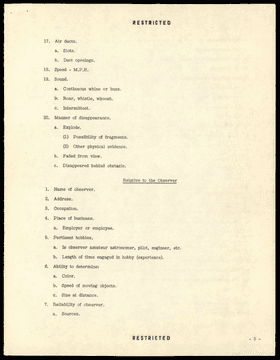
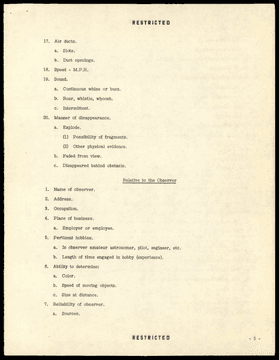
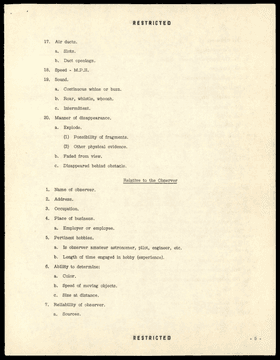
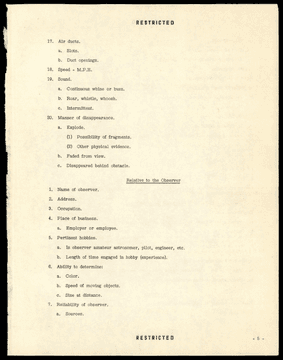
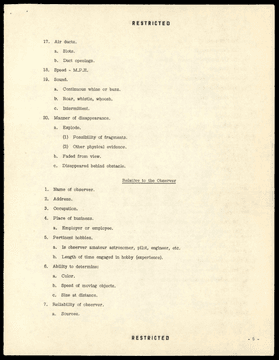
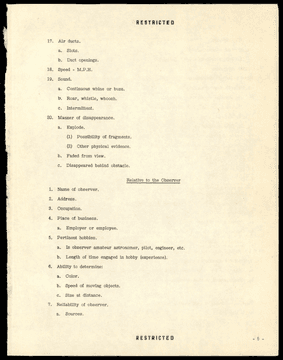
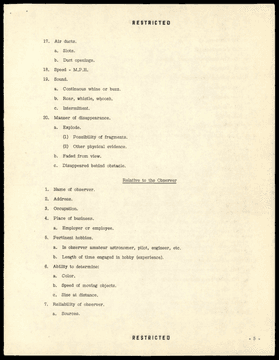
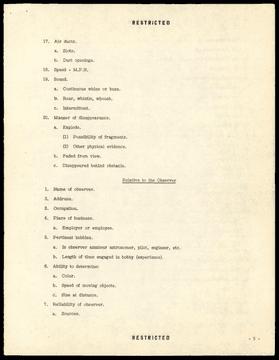
17. Air ducts.
   a. Slots.
   b. Duct openings.
18. Speed - M.P.H.
19. Sound.
   a. Continuous whine or buzz.
   b. Roar, whistle, whoosh.
   c. Intermittent.
20. Manner of disappearance.
   a. Explode.
      (1) Possibility of fragments.
      (2) Other physical evidence.
   b. Faded from view.
   c. Disappeared behind obstacle.

Relative to the Observer

1. Name of observer.
2. Address.
3. Occupation.
4. Place of business.
   a. Employer or employee.
5. Pertinent hobbies.
   a. Is observer amateur astronomer, pilot, engineer, etc.
   b. Length of time engaged in hobby (experience).
6. Ability to determine:
   a. Color.
   b. Speed of moving objects.
   c. Size at distance.
7. Reliability of observer.
   a. Sources.

RESTRICTED
- 5 -

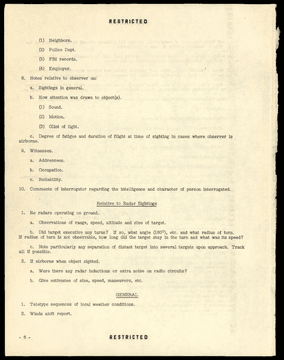
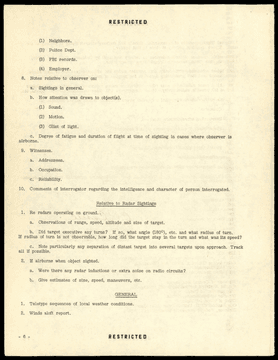
PAGE 7

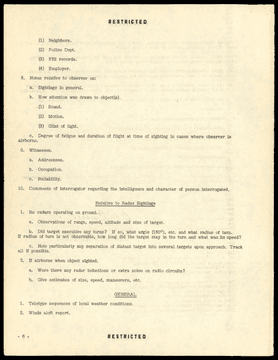
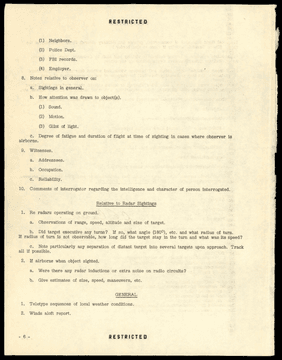
form

This page is a continuation of a questionnaire or reporting form for UFO/UAP sightings, detailing criteria for observer notes, witness reliability, radar sightings, and general weather data.

RESTRICTED

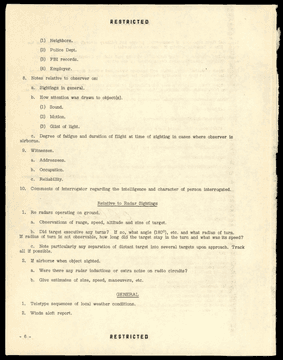
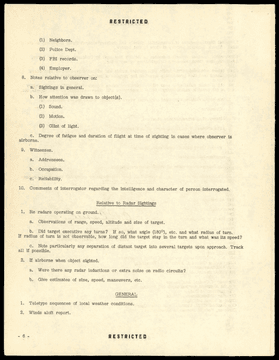
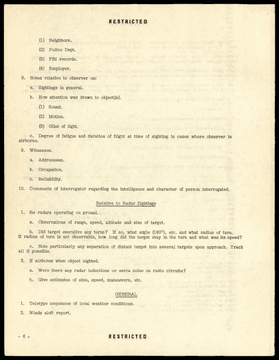
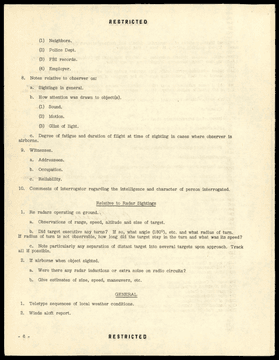
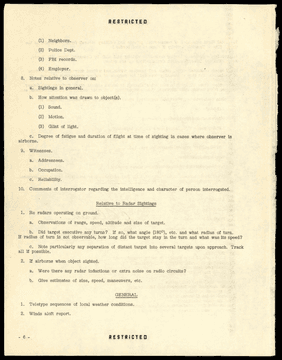
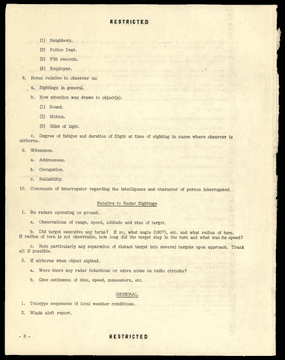
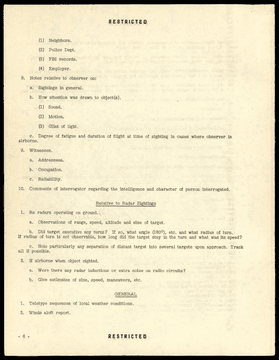
(1) Neighbors.
(2) Police Dept.
(3) FBI records.
(4) Employer.
8. Notes relative to observer on:
a. Sightings in general.
b. How attention was drawn to object(s).
(1) Sound.
(2) Motion.
(3) Glint of light.
c. Degree of fatigue and duration of flight at time of sighting in cases where observer is airborne.
9. Witnesses.
a. Addressees.
b. Occupation.
c. Reliability.
10. Comments of interrogator regarding the intelligence and character of person interrogated.

Relative to Radar Sightings

1. Re radars operating on ground.
a. Observations of range, speed, altitude and size of target.
b. Did target executive any turns? If so, what angle (180°), etc. and what radius of turn. If radius of turn is not observable, how long did the target stay in the turn and what was its speed?
c. Note particularly any separation of distant target into several targets upon approach. Track all if possible.
2. If airborne when object sighted.
a. Were there any radar inductions or extra noise on radio circuits?
b. Give estimates of size, speed, maneuvers, etc.

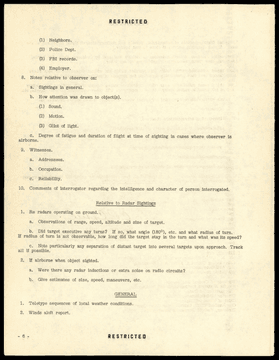
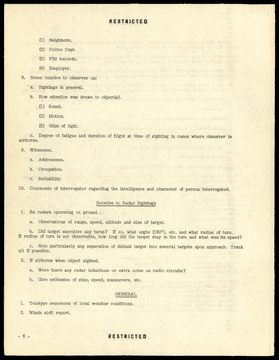
GENERAL

1. Teletype sequences of local weather conditions.
2. Winds aloft report.

- 6 - RESTRICTED

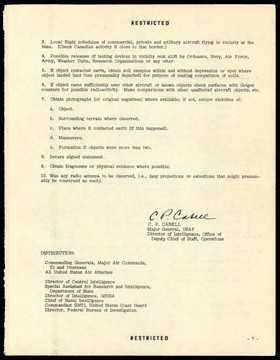
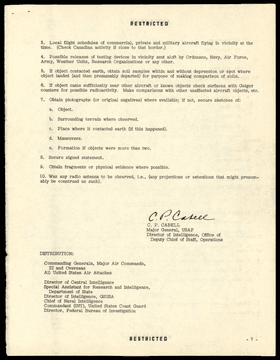
PAGE 8

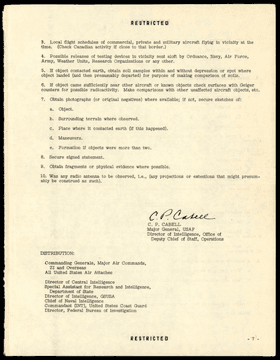
memo

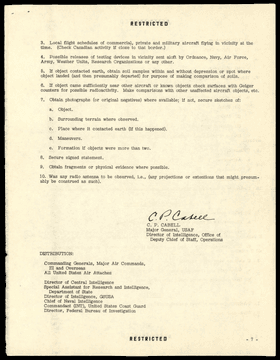
This page outlines specific investigative procedures for reporting unidentified aerial phenomena, including checking flight schedules, testing for radioactivity, and collecting physical evidence, signed by Major General C. P. Cabell.

RESTRICTED

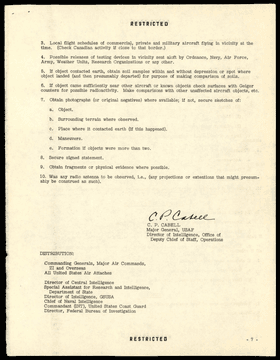
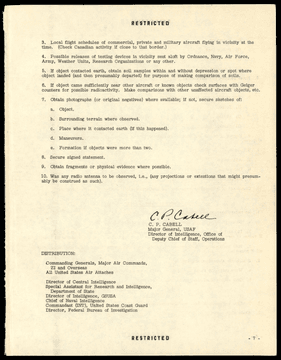
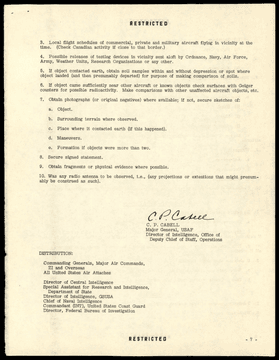
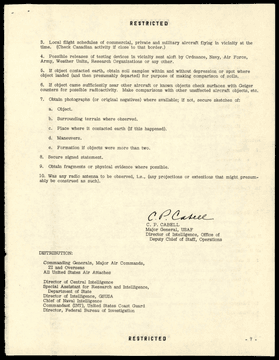
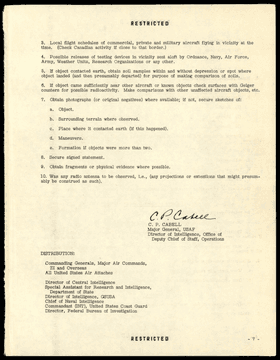
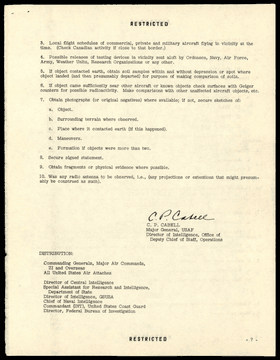
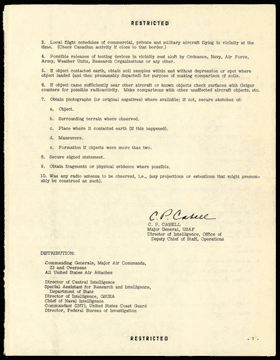
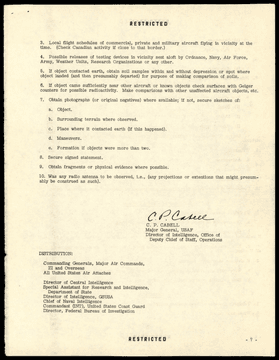
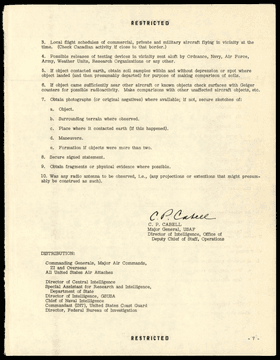
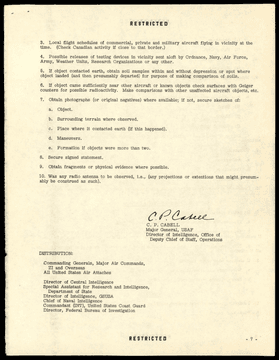
3. Local flight schedules of commercial, private and military aircraft flying in vicinity at the time. (Check Canadian activity if close to that border.)

4. Possible releases of testing devices in vicinity sent aloft by Ordnance, Navy, Air Force, Army, Weather Units, Research Organizations or any other.

5. If object contacted earth, obtain soil samples within and without depression or spot where object landed (and then presumably departed) for purpose of making comparison of soils.

6. If object came sufficiently near other aircraft or known objects check surfaces with Geiger counters for possible radioactivity. Make comparisons with other unaffected aircraft objects, etc.

7. Obtain photographs (or original negatives) where available; if not, secure sketches of:

a. Object.

b. Surrounding terrain where observed.

c. Place where it contacted earth (if this happened).

d. Maneuvers.

e. Formation if objects were more than two.

8. Secure signed statement.

9. Obtain fragments or physical evidence where possible.

10. Was any radio antenna to be observed, i.e., (any projections or extentions that might presumably be construed as such).

C. P. CABELL
Major General, USAF
Director of Intelligence, Office of
Deputy Chief of Staff, Operations

DISTRIBUTION:

Commanding Generals, Major Air Commands,
ZI and Overseas
All United States Air Attaches

Director of Central Intelligence
Special Assistant for Research and Intelligence,
Department of State
Director of Intelligence, GSUSA
Chief of Naval Intelligence
Commandant (INT), United States Coast Guard
Director, Federal Bureau of Investigation

RESTRICTED
- 7 -

PAGE 9

blank

This page is a blank sheet of paper with the word RESTRICTED printed at the top and bottom.

RESTRICTED

RESTRICTED

PAGE 10

memo

This memorandum from the Department of the Air Force outlines requirements and reporting procedures for sightings of unconventional aircraft and unidentified flying objects.

RESTRICTED

DEPARTMENT OF THE AIR FORCE
HEADQUARTERS UNITED STATES AIR FORCE
DIRECTORATE OF INTELLIGENCE
WASHINGTON 25, D. C.

15 February 1949

AIR INTELLIGENCE REQUIREMENTS
MEMORANDUM NUMBER 4

UNCONVENTIONAL AIRCRAFT

PART I - GENERAL

1. PURPOSE

The purpose of this memorandum is twofold:

a. To enunciate continuing Air Force requirements for information pertaining to sightings of unconventional aircraft and unidentified flying objects, including the so-called "Flying Discs."

b. To establish procedures for reporting such information.

2. RESCISSION

Department of the Army Collection Memorandum Number 7, dated 21 January 1948, and letter, CSGID 425.1, dated 25 March 1948, both subject as above, which have been transferred to Air Force agencies for action, are herewith superseded.

3. REPORTING

a. General

(1) As complete an answer to the requirements enunciated in Part II, as may be procurable, should be dispatched by means of electrical transmission immediately after sightings.

(2) Supplementary reports should be forwarded as available by the most expeditious means consistent with the importance of the information reported.

b. Major Air Commands (Overseas) and Air Attaches

(1) Initial and supplementary cabled reports will be transmitted to the Director of Intelligence, Headquarters United States Air Force. Cables will contain the phase, "Pass to COMGENAMC WRIGHT-PATTERSON AFB, DAYTON, OHIO, ATTN: MCIAXO-3."

RESTRICTED
[HANDWRITTEN: 65-83894-164] C9-4892,AF

PAGE 11

report

This page outlines reporting procedures for UAP sightings, specifying that reports should be sent to the Air Materiel Command at Wright-Patterson Air Force Base using AF Form 112, and lists the required information for such reports.

RESTRICTED

(2) Supplementary written reports, prepared on AF Form 112, will be forwarded to the Director of Intelligence, Headquarters United States Air Force.

(3) Commanding General, Air Materiel Command is authorized direct contact with major Air Commands (overseas) and organizations under their control in connection with the development of information on this subject.

c. Major Air Commands (ZI)

(1) Reports will be forwarded direct to the Commanding General, Air Materiel Command, Wright-Patterson Air Force Base, Dayton, Ohio, Attn: MCIAXO-3 by installations receiving information pertaining to the requirements enunciated in Part II.

(2) Copies of such reports may be supplied the Command Headquarters of the installation concerned.

(3) A copy of all reports sent to Air Materiel Command in accordance with these instructions will be forwarded at the same time to the Director of Intelligence, Headquarters United States Air Force.

(4) Written reports will be submitted on AF Form 112.

(5) Commanding General, Air Materiel Command is authorized direct contact with major Air Commands (ZI) and organizations under their control in connection with the development of information on this subject.

d. Non-Air Force Agencies

(1) Addressees other than those of the United States Air Force are requested to forward reports direct to the Commanding General, Air Materiel Command, Wright-Patterson Air Force Base, Dayton, Ohio, Attn: MCIAXO-3.

(2) In order to reduce the time factor involved in transmission of this type of information it is requested that, wherever communications facilities permit, subordinate elements be authorized to communicate reports direct to the Commanding General, Air Materiel Command.

PART II - REQUIREMENTS

General

1. Date of sighting.
2. Time of sighting (zonal by 24 hr. clock).
3. Where sighted (observer's position):

a. Ground
(1) City, town.
(2) Distance and direction from city or town, road, intersection, etc.
(3) From building (story), yard, etc.
(4) Map coordinates (if feasible) showing latitude and longitude.

- 2 - RESTRICTED
PAGE 12

form

This page is a continuation of a reporting form for unidentified aerial phenomena, listing specific data points to be collected regarding sightings, such as object appearance, maneuvers, and environmental context.

RESTRICTED

b. Air
(1) Type aircraft, speed, altitude, direction of flight.
(2) Distance and direction from city, town or known landmark.
(3) Clock position of object from observer's aircraft.
(4) Latitude and longitude.
c. Sea
(1) Latitude and longitude.
(2) Proximity to land. (Name city, country, etc.)
4. Number of objects.
Formation type (if any), sketch if possible.
5. Observable celestial phenomena or planets that may account for the sighting. (Local facilities or organizations which follow such celestial phenomena should be consulted for such information.)
6. Distance of object from observer.
a. Laterally or horizontally.
b. Angle of elevation from horizon.
c. Altitude.
7. Time in sight.
8. Appearance of object.
a. Color.
b. Shape. (Sketch if possible)
c. Apparent construction. (Of what material or substance)
d. Size.
(1) Estimated size.
(2) Size as it appeared from observer's view. (Compared to known object)
9. Direction of flight.
10. Tactics or maneuvers.
Vertical ascent or descent, horizontal, oscillating, fluttering, evasive, aggressive, erratic, etc.
11. Evidence of exhaust.
a. Color of smoke.
b. Length and width.

RESTRICTED - 3 -

PAGE 13

report

This page is a continuation of a technical questionnaire or checklist used for observing and reporting unidentified aerial phenomena, specifically detailing categories for cloud effects, lights, support mechanisms, propulsion, and control/stability.

RESTRICTED

c. Odor (if any).
d. Rate of evaporation.
e. Does trail vary with sound? (spurts)
12. Effect on clouds.
a. Opened path thru clouds.
b. Forced cloud or mists.
c. Reflected on cloud.
d. Showed thru cloud.
13. Lights.
a. Reflected or attached.
b. Luminous
c. Blinked on and off in relation to speed.
14. Support
a. Wings.
b. Aerodynamic list of fuselage.
c. Vertical jet.
d. Rotating cylinder or cone.
e. Aerostatic lift (balloon or dirigible).
15. Propulsion.
a. Propeller or jet.
b. Rotor.
c. Aerodynamic vanes (flapping or oscillating) (Katz Mayer effect).
d. Visible exhaust or jet openings.
16. Control and stability.
a. Fins
b. Stabilizers (horizontal or vertical).
(1) Size.
(2) Shape.
(3) Location.

- 4 - RESTRICTED

PAGE 14

form

This page is a continuation of a questionnaire or reporting form for UFO/UAP sightings, listing categories for physical characteristics of the object and observer background information.

RESTRICTED

17. Air ducts.
    a. Slots.
    b. Duct openings.
18. Speed - M.P.H.
19. Sound.
    a. Continuous whine or buzz.
    b. Roar, whistle, whoosh.
    c. Intermittent.
20. Manner of disappearance.
    a. Explode.
        (1) Possibility of fragments.
        (2) Other physical evidence.
    b. Faded from view.
    c. Disappeared behind obstacle.

Relative to the Observer

1. Name of observer.
2. Address.
3. Occupation.
4. Place of business.
    a. Employer or employee.
5. Pertinent hobbies.
    a. Is observer amateur astronomer, pilot, engineer, etc.
    b. Length of time engaged in hobby (experience).
6. Ability to determine:
    a. Color.
    b. Speed of moving objects.
    c. Size at distance.
7. Reliability of observer.
    a. Sources.

RESTRICTED
- 5 -

PAGE 15

form

This page is a section of a form or questionnaire outlining criteria for reporting and investigating UFO/UAP sightings, including observer details, witness reliability, radar data, and general weather conditions.

RESTRICTED

(1) Neighbors.
(2) Police Dept.
(3) FBI records.
(4) Employer.
8. Notes relative to observer on:
a. Sightings in general.
b. How attention was drawn to object(s).
(1) Sound.
(2) Motion.
(3) Glint of light.
c. Degree of fatigue and duration of flight at time of sighting in cases where observer is
airborne.
9. Witnesses.
a. Addressees.
b. Occupation.
c. Reliability.
10. Comments of interrogator regarding the intelligence and character of person interrogated.

Relative to Radar Sightings

1. Re radars operating on ground.
a. Observations of range, speed, altitude and size of target.
b. Did target executive any turns? If so, what angle (180o), etc. and what radius of turn.
If radius of turn is not observable, how long did the target stay in the turn and what was its speed?
c. Note particularly any separation of distant target into several targets upon approach. Track
all if possible.
2. If airborne when object sighted.
a. Were there any radar inductions or extra noise on radio circuits?
b. Give estimates of size, speed, maneuvers, etc.

GENERAL

1. Teletype sequences of local weather conditions.
2. Winds aloft report.

- 6 - RESTRICTED

PAGE 16

memo

This page provides a list of instructions (items 3-10) for investigating unidentified aerial objects, including checking flight schedules, testing devices, soil samples, radioactivity, and obtaining physical evidence or documentation, signed by Major General C. P. Cabell.

RESTRICTED

3. Local flight schedules of commercial, private and military aircraft flying in vicinity at the time. (Check Canadian activity if close to that border.)

4. Possible releases of testing devices in vicinity sent aloft by Ordnance, Navy, Air Force, Army, Weather Units, Research Organizations or any other.

5. If object contacted earth, obtain soil samples within and without depression or spot where object landed (and then presumably departed) for purpose of making comparison of soils.

6. If object came sufficiently near other aircraft or known objects check surfaces with Geiger counters for possible radioactivity. Make comparisons with other unaffected aircraft objects, etc.

7. Obtain photographs (or original negatives) where available; if not, secure sketches of:

a. Object.

b. Surrounding terrain where observed.

c. Place where it contacted earth (if this happened).

d. Maneuvers.

e. Formation if objects were more than two.

8. Secure signed statement.

9. Obtain fragments or physical evidence where possible.

10. Was any radio antenna to be observed, i.e., (any projections or extentions that might presumably be construed as such).

C. P. CABELL
C. P. CABELL
Major General, USAF
Director of Intelligence, Office of
Deputy Chief of Staff, Operations

DISTRIBUTION:

Commanding Generals, Major Air Commands,
ZI and Overseas
All United States Air Attaches

Director of Central Intelligence
Special Assistant for Research and Intelligence,
Department of State
Director of Intelligence, GSUSA
Chief of Naval Intelligence
Commandant (INT), United States Coast Guard
Director, Federal Bureau of Investigation

RESTRICTED
- 7 -

PAGE 17

PAGE 18

memo

This is Air Intelligence Requirements Memorandum Number 4, dated 15 February 1949, which establishes procedures for reporting sightings of unconventional aircraft and unidentified flying objects (UFOs) to the U.S. Air Force.

RESTRICTED

DEPARTMENT OF THE AIR FORCE
HEADQUARTERS UNITED STATES AIR FORCE
DIRECTORATE OF INTELLIGENCE
WASHINGTON 25, D. C.

15 February 1949

AIR INTELLIGENCE REQUIREMENTS
MEMORANDUM NUMBER 4

UNCONVENTIONAL AIRCRAFT

PART I - GENERAL

1. PURPOSE

The purpose of this memorandum is twofold:

a. To enunciate continuing Air Force requirements for information pertaining to sightings of unconventional aircraft and unidentified flying objects, including the so-called "Flying Discs."

b. To establish procedures for reporting such information.

2. RESCISSION

Department of the Army Collection Memorandum Number 7, dated 21 January 1948, and letter, CSGID 425.1, dated 25 March 1948, both subject as above, which have been transferred to Air Force agencies for action, are herewith superseded.

3. REPORTING

a. General

(1) As complete an answer to the requirements enunciated in Part II, as may be procurable, should be dispatched by means of electrical transmission immediately after sightings.

(2) Supplementary reports should be forwarded as available by the most expeditious means consistent with the importance of the information reported.

b. Major Air Commands (Overseas) and Air Attaches

(1) Initial and supplementary cabled reports will be transmitted to the Director of Intelligence, Headquarters United States Air Force. Cables will contain the phase, "Pass to COMGENAMC WRIGHT-PATTERSON AFB, DAYTON, OHIO, ATTN: MCIAXO-3."

RESTRICTED
[HANDWRITTEN: 65- 83894-164]
C9-4892,AF

PAGE 19

report

This page outlines the reporting procedures for UAP sightings, specifying the routing of reports to the Air Materiel Command and the Director of Intelligence, and lists the initial requirements for sighting reports.

RESTRICTED

(2) Supplementary written reports, prepared on AF Form 112, will be forwarded to the Director of Intelligence, Headquarters United States Air Force.

(3) Commanding General, Air Materiel Command is authorized direct contact with major Air Commands (overseas) and organizations under their control in connection with the development of information on this subject.

c. Major Air Commands (ZI)

(1) Reports will be forwarded direct to the Commanding General, Air Materiel Command, Wright-Patterson Air Force Base, Dayton, Ohio, Attn: MCIAXO-3 by installations receiving information pertaining to the requirements enunciated in Part II.

(2) Copies of such reports may be supplied the Command Headquarters of the installation concerned.

(3) A copy of all reports sent to Air Materiel Command in accordance with these instructions will be forwarded at the same time to the Director of Intelligence, Headquarters United States Air Force.

(4) Written reports will be submitted on AF Form 112.

(5) Commanding General, Air Materiel Command is authorized direct contact with major Air Commands (ZI) and organizations under their control in connection with the development of information on this subject.

d. Non-Air Force Agencies

(1) Addressees other than those of the United States Air Force are requested to forward reports direct to the Commanding General, Air Materiel Command, Wright-Patterson Air Force Base, Dayton, Ohio, Attn: MCIAXO-3.

(2) In order to reduce the time factor involved in transmission of this type of information it is requested that, wherever communications facilities permit, subordinate elements be authorized to communicate reports direct to the Commanding General, Air Materiel Command.

PART II - REQUIREMENTS

General

1. Date of sighting.

2. Time of sighting (zonal by 24 hr. clock).

3. Where sighted (observer's position):

a. Ground

(1) City, town.

(2) Distance and direction from city or town, road, intersection, etc.

(3) From building (story), yard, etc.

(4) Map coordinates (if feasible) showing latitude and longitude.

- 2 - RESTRICTED
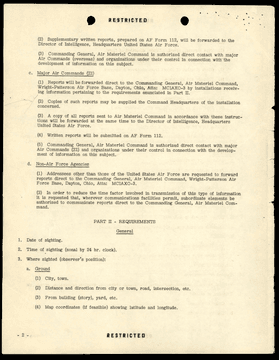
PAGE 20

report

This page is a continuation of a reporting form or instruction manual detailing specific criteria for documenting unidentified aerial phenomena, including physical characteristics, maneuvers, and environmental context.

RESTRICTED

b. Air
(1) Type aircraft, speed, altitude, direction of flight.
(2) Distance and direction from city, town or known landmark.
(3) Clock position of object from observer's aircraft.
(4) Latitude and longitude.
c. Sea
(1) Latitude and longitude.
(2) Proximity to land. (Name city, country, etc.)
4. Number of objects.
Formation type (if any), sketch if possible.
5. Observable celestial phenomena or planets that may account for the sighting. (Local facilities or organizations which follow such celestial phenomena should be consulted for such information.)
6. Distance of object from observer.
a. Laterally or horizontally.
b. Angle of elevation from horizon.
c. Altitude.
7. Time in sight.
8. Appearance of object.
a. Color.
b. Shape. (Sketch if possible)
c. Apparent construction. (Of what material or substance)
d. Size.
(1) Estimated size.
(2) Size as it appeared from observer's view. (Compared to known object)
9. Direction of flight.
10. Tactics or maneuvers.
Vertical ascent or descent, horizontal, oscillating, fluttering, evasive, aggressive, erratic, etc.
11. Evidence of exhaust.
a. Color of smoke.
b. Length and width.

RESTRICTED
- 3 -

PAGE 21

report

This page is a continuation of a technical questionnaire or checklist used for reporting unidentified aerial phenomena, specifically detailing characteristics like cloud effects, lighting, support mechanisms, propulsion, and control surfaces.

RESTRICTED

c. Odor (if any).
d. Rate of evaporation.
e. Does trail vary with sound? (spurts)
12. Effect on clouds.
a. Opened path thru clouds.
b. Forced cloud or mists.
c. Reflected on cloud.
d. Showed thru cloud.
13. Lights.
a. Reflected or attached.
b. Luminous
c. Blinked on and off in relation to speed.
14. Support
a. Wings.
b. Aerodynamic list of fuselage.
c. Vertical jet.
d. Rotating cylinder or cone.
e. Aerostatic lift (balloon or dirigible).
15. Propulsion.
a. Propeller or jet.
b. Rotor.
c. Aerodynamic vanes (flapping or oscillating) (Katz Mayer effect).
d. Visible exhaust or jet openings.
16. Control and stability.
a. Fins
b. Stabilizers (horizontal or vertical).
(1) Size.
(2) Shape.
(3) Location.

- 4 - RESTRICTED

PAGE 22

form

This page is a continuation of a questionnaire or reporting form for UFO/UAP sightings, detailing physical characteristics of the object and information regarding the observer.

RESTRICTED

17. Air ducts.
   a. Slots.
   b. Duct openings.
18. Speed - M.P.H.
19. Sound.
   a. Continuous whine or buzz.
   b. Roar, whistle, whoosh.
   c. Intermittent.
20. Manner of disappearance.
   a. Explode.
      (1) Possibility of fragments.
      (2) Other physical evidence.
   b. Faded from view.
   c. Disappeared behind obstacle.

Relative to the Observer

1. Name of observer.
2. Address.
3. Occupation.
4. Place of business.
   a. Employer or employee.
5. Pertinent hobbies.
   a. Is observer amateur astronomer, pilot, engineer, etc.
   b. Length of time engaged in hobby (experience).
6. Ability to determine:
   a. Color.
   b. Speed of moving objects.
   c. Size at distance.
7. Reliability of observer.
   a. Sources.

RESTRICTED
- 5 -

PAGE 23

form

This page is a continuation of a questionnaire or reporting form outlining criteria for documenting UFO/UAP sightings, specifically regarding observer notes, witness reliability, radar observations, and general weather data.

RESTRICTED

(1) Neighbors.
(2) Police Dept.
(3) FBI records.
(4) Employer.
8. Notes relative to observer on:
a. Sightings in general.
b. How attention was drawn to object(s).
(1) Sound.
(2) Motion.
(3) Glint of light.
c. Degree of fatigue and duration of flight at time of sighting in cases where observer is airborne.
9. Witnesses.
a. Addressees.
b. Occupation.
c. Reliability.
10. Comments of interrogator regarding the intelligence and character of person interrogated.

Relative to Radar Sightings
1. Re radars operating on ground.
a. Observations of range, speed, altitude and size of target.
b. Did target executive any turns? If so, what angle (180o), etc. and what radius of turn. If radius of turn is not observable, how long did the target stay in the turn and what was its speed?
c. Note particularly any separation of distant target into several targets upon approach. Track all if possible.
2. If airborne when object sighted.
a. Were there any radar inductions or extra noise on radio circuits?
b. Give estimates of size, speed, maneuvers, etc.

GENERAL
1. Teletype sequences of local weather conditions.
2. Winds aloft report.

- 6 - RESTRICTED

PAGE 24

memo

This page provides a list of instructions (items 3-10) for investigating unidentified aerial objects, including checking flight schedules, testing devices, soil samples, radioactivity, and gathering physical evidence or documentation, signed by Major General C. P. Cabell.

RESTRICTED

3. Local flight schedules of commercial, private and military aircraft flying in vicinity at the time. (Check Canadian activity if close to that border.)

4. Possible releases of testing devices in vicinity sent aloft by Ordnance, Navy, Air Force, Army, Weather Units, Research Organizations or any other.

5. If object contacted earth, obtain soil samples within and without depression or spot where object landed (and then presumably departed) for purpose of making comparison of soils.

6. If object came sufficiently near other aircraft or known objects check surfaces with Geiger counters for possible radioactivity. Make comparisons with other unaffected aircraft objects, etc.

7. Obtain photographs (or original negatives) where available; if not, secure sketches of:

a. Object.

b. Surrounding terrain where observed.

c. Place where it contacted earth (if this happened).

d. Maneuvers.

e. Formation if objects were more than two.

8. Secure signed statement.

9. Obtain fragments or physical evidence where possible.

10. Was any radio antenna to be observed, i.e., (any projections or extentions that might presumably be construed as such).

C. P. CABELL
Major General, USAF
Director of Intelligence, Office of
Deputy Chief of Staff, Operations

DISTRIBUTION:

Commanding Generals, Major Air Commands,
ZI and Overseas
All United States Air Attaches

Director of Central Intelligence
Special Assistant for Research and Intelligence,
Department of State
Director of Intelligence, GSUSA
Chief of Naval Intelligence
Commandant (INT), United States Coast Guard
Director, Federal Bureau of Investigation

RESTRICTED
- 7 -

PAGE 25

blank

This is a blank page with only the word 'RESTRICTED' printed at the top and bottom.

RESTRICTED

RESTRICTED

PAGE 26

memo

This is Air Intelligence Requirements Memorandum Number 4, dated 15 February 1949, which establishes procedures for reporting sightings of unconventional aircraft and unidentified flying objects.

RESTRICTED

DEPARTMENT OF THE AIR FORCE
HEADQUARTERS UNITED STATES AIR FORCE
DIRECTORATE OF INTELLIGENCE
WASHINGTON 25, D. C.

15 February 1949

AIR INTELLIGENCE REQUIREMENTS
MEMORANDUM NUMBER 4

UNCONVENTIONAL AIRCRAFT

PART I - GENERAL

1. PURPOSE

The purpose of this memorandum is twofold:

a. To enunciate continuing Air Force requirements for information pertaining to sightings of unconventional aircraft and unidentified flying objects, including the so-called "Flying Discs."

b. To establish procedures for reporting such information.

2. RESCISSION

Department of the Army Collection Memorandum Number 7, dated 21 January 1948, and letter, CSGID 425.1, dated 25 March 1948, both subject as above, which have been transferred to Air Force agencies for action, are herewith superseded.

3. REPORTING

a. General

(1) As complete an answer to the requirements enunciated in Part II, as may be procurable, should be dispatched by means of electrical transmission immediately after sightings.

(2) Supplementary reports should be forwarded as available by the most expeditious means consistent with the importance of the information reported.

b. Major Air Commands (Overseas) and Air Attaches

(1) Initial and supplementary cabled reports will be transmitted to the Director of Intelligence, Headquarters United States Air Force. Cables will contain the phase, "Pass to COMGENAMC WRIGHT-PATTERSON AFB, DAYTON, OHIO, ATTN: MCIAXO-3."

RESTRICTED
C9-4892, AF
[HANDWRITTEN: 65-83894-164]

PAGE 27

memo

This page outlines reporting procedures for UAP sightings, specifying that reports should be sent to the Air Materiel Command at Wright-Patterson Air Force Base and detailing the required information for such reports.

RESTRICTED

(2) Supplementary written reports, prepared on AF Form 112, will be forwarded to the
Director of Intelligence, Headquarters United States Air Force.

(3) Commanding General, Air Materiel Command is authorized direct contact with major
Air Commands (overseas) and organizations under their control in connection with the
development of information on this subject.

c. Major Air Commands (ZI)

(1) Reports will be forwarded direct to the Commanding General, Air Materiel Command,
Wright-Patterson Air Force Base, Dayton, Ohio, Attn: MCIAXO-3 by installations receiv-
ing information pertaining to the requirements enunciated in Part II.

(2) Copies of such reports may be supplied the Command Headquarters of the installation
concerned.

(3) A copy of all reports sent to Air Materiel Command in accordance with these instruc-
tions will be forwarded at the same time to the Director of Intelligence, Headquarters
United States Air Force.

(4) Written reports will be submitted on AF Form 112.

(5) Commanding General, Air Materiel Command is authorized direct contact with major
Air Commands (ZI) and organizations under their control in connection with the develop-
ment of information on this subject.

d. Non-Air Force Agencies

(1) Addressees other than those of the United States Air Force are requested to forward
reports direct to the Commanding General, Air Materiel Command, Wright-Patterson Air
Force Base, Dayton, Ohio, Attn: MCIAXO-3.

(2) In order to reduce the time factor involved in transmission of this type of information
it is requested that, wherever communications facilities permit, subordinate elements be
authorized to communicate reports direct to the Commanding General, Air Materiel Com-
mand.

PART II - REQUIREMENTS

General

1. Date of sighting.

2. Time of sighting (zonal by 24 hr. clock).

3. Where sighted (observer's position):

a. Ground

(1) City, town.

(2) Distance and direction from city or town, road, intersection, etc.

(3) From building (story), yard, etc.

(4) Map coordinates (if feasible) showing latitude and longitude.

- 2 - RESTRICTED
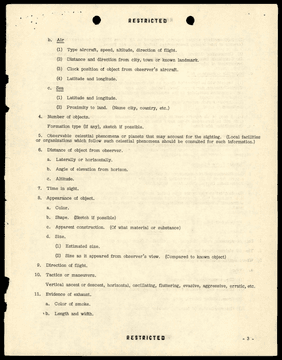
PAGE 28

form

This page is a continuation of a reporting form or questionnaire detailing specific criteria for documenting unidentified aerial phenomena, including physical characteristics, flight behavior, and environmental context.

RESTRICTED

b. Air
(1) Type aircraft, speed, altitude, direction of flight.
(2) Distance and direction from city, town or known landmark.
(3) Clock position of object from observer's aircraft.
(4) Latitude and longitude.
c. Sea
(1) Latitude and longitude.
(2) Proximity to land. (Name city, country, etc.)
4. Number of objects.
Formation type (if any), sketch if possible.
5. Observable celestial phenomena or planets that may account for the sighting. (Local facilities or organizations which follow such celestial phenomena should be consulted for such information.)
6. Distance of object from observer.
a. Laterally or horizontally.
b. Angle of elevation from horizon.
c. Altitude.
7. Time in sight.
8. Appearance of object.
a. Color.
b. Shape. (Sketch if possible)
c. Apparent construction. (Of what material or substance)
d. Size.
(1) Estimated size.
(2) Size as it appeared from observer's view. (Compared to known object)
9. Direction of flight.
10. Tactics or maneuvers.
Vertical ascent or descent, horizontal, oscillating, fluttering, evasive, aggressive, erratic, etc.
11. Evidence of exhaust.
a. Color of smoke.
b. Length and width.

RESTRICTED - 3 -

PAGE 29

report

This page is a continuation of a technical questionnaire or checklist used for reporting observations of unidentified aerial phenomena, specifically detailing categories for cloud effects, lights, support mechanisms, propulsion, and control/stability.

RESTRICTED

c. Odor (if any).
d. Rate of evaporation.
e. Does trail vary with sound? (spurts)
12. Effect on clouds.
a. Opened path thru clouds.
b. Forced cloud or mists.
c. Reflected on cloud.
d. Showed thru cloud.
13. Lights.
a. Reflected or attached.
b. Luminous
c. Blinked on and off in relation to speed.
14. Support
a. Wings.
b. Aerodynamic list of fuselage.
c. Vertical jet.
d. Rotating cylinder or cone.
e. Aerostatic lift (balloon or dirigible).
15. Propulsion.
a. Propeller or jet.
b. Rotor.
c. Aerodynamic vanes (flapping or oscillating) (Katz Mayer effect).
d. Visible exhaust or jet openings.
16. Control and stability.
a. Fins
b. Stabilizers (horizontal or vertical).
(1) Size.
(2) Shape.
(3) Location.

- 4 - RESTRICTED

PAGE 30

form

This page is a continuation of a questionnaire or reporting form, listing criteria for describing aerial phenomena and the observer's background.

RESTRICTED

17. Air ducts.
   a. Slots.
   b. Duct openings.
18. Speed - M.P.H.
19. Sound.
   a. Continuous whine or buzz.
   b. Roar, whistle, whoosh.
   c. Intermittent.
20. Manner of disappearance.
   a. Explode.
      (1) Possibility of fragments.
      (2) Other physical evidence.
   b. Faded from view.
   c. Disappeared behind obstacle.

Relative to the Observer

1. Name of observer.
2. Address.
3. Occupation.
4. Place of business.
   a. Employer or employee.
5. Pertinent hobbies.
   a. Is observer amateur astronomer, pilot, engineer, etc.
   b. Length of time engaged in hobby (experience).
6. Ability to determine:
   a. Color.
   b. Speed of moving objects.
   c. Size at distance.
7. Reliability of observer.
   a. Sources.

RESTRICTED
- 5 -

PAGE 31

form

This page is a continuation of a questionnaire or reporting form regarding UFO/UAP sightings, specifically detailing information to be collected about observers, witnesses, and radar data.

RESTRICTED

(1) Neighbors.
(2) Police Dept.
(3) FBI records.
(4) Employer.
8. Notes relative to observer on:
a. Sightings in general.
b. How attention was drawn to object(s).
(1) Sound.
(2) Motion.
(3) Glint of light.
c. Degree of fatigue and duration of flight at time of sighting in cases where observer is airborne.
9. Witnesses.
a. Addressees.
b. Occupation.
c. Reliability.
10. Comments of interrogator regarding the intelligence and character of person interrogated.

Relative to Radar Sightings

1. Re radars operating on ground.
a. Observations of range, speed, altitude and size of target.
b. Did target executive any turns? If so, what angle (180°), etc. and what radius of turn. If radius of turn is not observable, how long did the target stay in the turn and what was its speed?
c. Note particularly any separation of distant target into several targets upon approach. Track all if possible.
2. If airborne when object sighted.
a. Were there any radar inductions or extra noise on radio circuits?
b. Give estimates of size, speed, maneuvers, etc.

GENERAL

1. Teletype sequences of local weather conditions.
2. Winds aloft report.

- 6 - RESTRICTED

PAGE 32

memo

This page outlines specific investigative procedures for reporting unidentified aerial objects, including checking flight schedules, testing for radioactivity, obtaining physical evidence, and documenting observations through photographs or sketches, signed by Major General C. P. Cabell.

RESTRICTED

3. Local flight schedules of commercial, private and military aircraft flying in vicinity at the time. (Check Canadian activity if close to that border.)

4. Possible releases of testing devices in vicinity sent aloft by Ordnance, Navy, Air Force, Army, Weather Units, Research Organizations or any other.

5. If object contacted earth, obtain soil samples within and without depression or spot where object landed (and then presumably departed) for purpose of making comparison of soils.

6. If object came sufficiently near other aircraft or known objects check surfaces with Geiger counters for possible radioactivity. Make comparisons with other unaffected aircraft objects, etc.

7. Obtain photographs (or original negatives) where available; if not, secure sketches of:

a. Object.

b. Surrounding terrain where observed.

c. Place where it contacted earth (if this happened).

d. Maneuvers.

e. Formation if objects were more than two.

8. Secure signed statement.

9. Obtain fragments or physical evidence where possible.

10. Was any radio antenna to be observed, i.e., (any projections or extentions that might presumably be construed as such).

C. P. CABELL
C. P. CABELL
Major General, USAF
Director of Intelligence, Office of
Deputy Chief of Staff, Operations

DISTRIBUTION:

Commanding Generals, Major Air Commands,
ZI and Overseas
All United States Air Attaches

Director of Central Intelligence
Special Assistant for Research and Intelligence,
Department of State
Director of Intelligence, GSUSA
Chief of Naval Intelligence
Commandant (INT), United States Coast Guard
Director, Federal Bureau of Investigation

RESTRICTED
- 7 -

PAGE 33

PAGE 34

memo

This memorandum outlines Air Force requirements for reporting sightings of unconventional aircraft and unidentified flying objects, superseding previous Army directives.

RESTRICTED

DEPARTMENT OF THE AIR FORCE
HEADQUARTERS UNITED STATES AIR FORCE
DIRECTORATE OF INTELLIGENCE
WASHINGTON 25, D. C.

15 February 1949

AIR INTELLIGENCE REQUIREMENTS
MEMORANDUM NUMBER 4

UNCONVENTIONAL AIRCRAFT

PART I - GENERAL

1. PURPOSE

The purpose of this memorandum is twofold:

a. To enunciate continuing Air Force requirements for information pertaining to sightings of unconventional aircraft and unidentified flying objects, including the so-called "Flying Discs."

b. To establish procedures for reporting such information.

2. RESCISSION

Department of the Army Collection Memorandum Number 7, dated 21 January 1948, and letter, CSGID 425.1, dated 25 March 1948, both subject as above, which have been transferred to Air Force agencies for action, are herewith superseded.

3. REPORTING

a. General

(1) As complete an answer to the requirements enunciated in Part II, as may be procurable, should be dispatched by means of electrical transmission immediately after sightings.

(2) Supplementary reports should be forwarded as available by the most expeditious means consistent with the importance of the information reported.

b. Major Air Commands (Overseas) and Air Attaches

(1) Initial and supplementary cabled reports will be transmitted to the Director of Intelligence, Headquarters United States Air Force. Cables will contain the phase, "Pass to COMGENAMC WRIGHT-PATTERSON AFB, DAYTON, OHIO, ATTN: MCIAXO-3."

RESTRICTED
[HANDWRITTEN: 65- 83894-164]
C9-4892, AF

PAGE 35

report

This page outlines administrative procedures for reporting information to the Air Materiel Command and the Director of Intelligence, and lists the initial requirements for reporting a sighting.

RESTRICTED

(2) Supplementary written reports, prepared on AF Form 112, will be forwarded to the
Director of Intelligence, Headquarters United States Air Force.

(3) Commanding General, Air Materiel Command is authorized direct contact with major
Air Commands (overseas) and organizations under their control in connection with the
development of information on this subject.

c. Major Air Commands (ZI)

(1) Reports will be forwarded direct to the Commanding General, Air Materiel Command,
Wright-Patterson Air Force Base, Dayton, Ohio, Attn: MCIAXO-3 by installations receiv-
ing information pertaining to the requirements enunciated in Part II.

(2) Copies of such reports may be supplied the Command Headquarters of the installation
concerned.

(3) A copy of all reports sent to Air Materiel Command in accordance with these instruc-
tions will be forwarded at the same time to the Director of Intelligence, Headquarters
United States Air Force.

(4) Written reports will be submitted on AF Form 112.

(5) Commanding General, Air Materiel Command is authorized direct contact with major
Air Commands (ZI) and organizations under their control in connection with the develop-
ment of information on this subject.

d. Non-Air Force Agencies

(1) Addressees other than those of the United States Air Force are requested to forward
reports direct to the Commanding General, Air Materiel Command, Wright-Patterson Air
Force Base, Dayton, Ohio, Attn: MCIAXO-3.

(2) In order to reduce the time factor involved in transmission of this type of information
it is requested that, wherever communications facilities permit, subordinate elements be
authorized to communicate reports direct to the Commanding General, Air Materiel Com-
mand.

PART II - REQUIREMENTS

General

1. Date of sighting.

2. Time of sighting (zonal by 24 hr. clock).

3. Where sighted (observer's position):

a. Ground

(1) City, town.

(2) Distance and direction from city or town, road, intersection, etc.

(3) From building (story), yard, etc.

(4) Map coordinates (if feasible) showing latitude and longitude.

- 2 - RESTRICTED
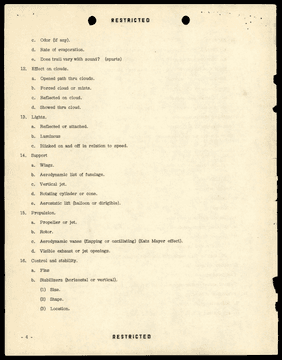
PAGE 36

form

This page is a continuation of a reporting form for UFO/UAP sightings, listing specific data points to be collected regarding the object's characteristics, movement, and appearance.

RESTRICTED

b. Air
(1) Type aircraft, speed, altitude, direction of flight.
(2) Distance and direction from city, town or known landmark.
(3) Clock position of object from observer's aircraft.
(4) Latitude and longitude.
c. Sea
(1) Latitude and longitude.
(2) Proximity to land. (Name city, country, etc.)
4. Number of objects.
Formation type (if any), sketch if possible.
5. Observable celestial phenomena or planets that may account for the sighting. (Local facilities or organizations which follow such celestial phenomena should be consulted for such information.)
6. Distance of object from observer.
a. Laterally or horizontally.
b. Angle of elevation from horizon.
c. Altitude.
7. Time in sight.
8. Appearance of object.
a. Color.
b. Shape. (Sketch if possible)
c. Apparent construction. (Of what material or substance)
d. Size.
(1) Estimated size.
(2) Size as it appeared from observer's view. (Compared to known object)
9. Direction of flight.
10. Tactics or maneuvers.
Vertical ascent or descent, horizontal, oscillating, fluttering, evasive, aggressive, erratic, etc.
11. Evidence of exhaust.
a. Color of smoke.
b. Length and width.

RESTRICTED - 3 -

PAGE 37

report

This page is a continuation of a questionnaire or checklist used to document observations of unidentified aerial phenomena, specifically covering cloud effects, lights, support mechanisms, propulsion, and control/stability.

RESTRICTED

c. Odor (if any).
d. Rate of evaporation.
e. Does trail vary with sound? (spurts)
12. Effect on clouds.
a. Opened path thru clouds.
b. Forced cloud or mists.
c. Reflected on cloud.
d. Showed thru cloud.
13. Lights.
a. Reflected or attached.
b. Luminous.
c. Blinked on and off in relation to speed.
14. Support
a. Wings.
b. Aerodynamic list of fuselage.
c. Vertical jet.
d. Rotating cylinder or cone.
e. Aerostatic lift (balloon or dirigible).
15. Propulsion.
a. Propeller or jet.
b. Rotor.
c. Aerodynamic vanes (flapping or oscillating) (Katz Mayer effect).
d. Visible exhaust or jet openings.
16. Control and stability.
a. Fins
b. Stabilizers (horizontal or vertical).
(1) Size.
(2) Shape.
(3) Location.
- 4 - RESTRICTED

PAGE 38

form

This page is a continuation of a questionnaire or reporting form, listing criteria for describing unidentified aerial phenomena and the observer's background.

RESTRICTED

17. Air ducts.
   a. Slots.
   b. Duct openings.
18. Speed - M.P.H.
19. Sound.
   a. Continuous whine or buzz.
   b. Roar, whistle, whoosh.
   c. Intermittent.
20. Manner of disappearance.
   a. Explode.
      (1) Possibility of fragments.
      (2) Other physical evidence.
   b. Faded from view.
   c. Disappeared behind obstacle.

Relative to the Observer

1. Name of observer.
2. Address.
3. Occupation.
4. Place of business.
   a. Employer or employee.
5. Pertinent hobbies.
   a. Is observer amateur astronomer, pilot, engineer, etc.
   b. Length of time engaged in hobby (experience).
6. Ability to determine:
   a. Color.
   b. Speed of moving objects.
   c. Size at distance.
7. Reliability of observer.
   a. Sources.

RESTRICTED
- 5 -

PAGE 39

form

This page is a continuation of a questionnaire or reporting form regarding UFO/UAP sightings, specifically detailing information to be collected about observers, witnesses, radar sightings, and general weather conditions.

RESTRICTED

(1) Neighbors.
(2) Police Dept.
(3) FBI records.
(4) Employer.
8. Notes relative to observer on:
a. Sightings in general.
b. How attention was drawn to object(s).
(1) Sound.
(2) Motion.
(3) Glint of light.
c. Degree of fatigue and duration of flight at time of sighting in cases where observer is airborne.
9. Witnesses.
a. Addressees.
b. Occupation.
c. Reliability.
10. Comments of interrogator regarding the intelligence and character of person interrogated.

Relative to Radar Sightings

1. Re radars operating on ground.
a. Observations of range, speed, altitude and size of target.
b. Did target executive any turns? If so, what angle (180°), etc. and what radius of turn. If radius of turn is not observable, how long did the target stay in the turn and what was its speed?
c. Note particularly any separation of distant target into several targets upon approach. Track all if possible.
2. If airborne when object sighted.
a. Were there any radar inductions or extra noise on radio circuits?
b. Give estimates of size, speed, maneuvers, etc.

GENERAL

1. Teletype sequences of local weather conditions.
2. Winds aloft report.

- 6 - RESTRICTED

PAGE 40

memo

This page outlines specific investigative procedures for reporting and documenting unidentified aerial objects, including collecting soil samples, checking for radioactivity, and obtaining photographic or physical evidence.

RESTRICTED

3. Local flight schedules of commercial, private and military aircraft flying in vicinity at the time. (Check Canadian activity if close to that border.)

4. Possible releases of testing devices in vicinity sent aloft by Ordnance, Navy, Air Force, Army, Weather Units, Research Organizations or any other.

5. If object contacted earth, obtain soil samples within and without depression or spot where object landed (and then presumably departed) for purpose of making comparison of soils.

6. If object came sufficiently near other aircraft or known objects check surfaces with Geiger counters for possible radioactivity. Make comparisons with other unaffected aircraft objects, etc.

7. Obtain photographs (or original negatives) where available; if not, secure sketches of:

a. Object.

b. Surrounding terrain where observed.

c. Place where it contacted earth (if this happened).

d. Maneuvers.

e. Formation if objects were more than two.

8. Secure signed statement.

9. Obtain fragments or physical evidence where possible.

10. Was any radio antenna to be observed, i.e., (any projections or extentions that might presumably be construed as such).

C. P. CABELL
Major General, USAF
Director of Intelligence, Office of
Deputy Chief of Staff, Operations

DISTRIBUTION:

Commanding Generals, Major Air Commands,
ZI and Overseas
All United States Air Attaches

Director of Central Intelligence
Special Assistant for Research and Intelligence,
Department of State
Director of Intelligence, GSUSA
Chief of Naval Intelligence
Commandant (INT), United States Coast Guard
Director, Federal Bureau of Investigation

RESTRICTED
- 7 -

PAGE 41

cover-page

This is a blank page marked with the word RESTRICTED at the top and bottom.

RESTRICTED

RESTRICTED

PAGE 42

memo

This is Air Intelligence Requirements Memorandum Number 4, dated February 15, 1949, regarding reporting procedures for sightings of unconventional aircraft and unidentified flying objects.

RESTRICTED

DEPARTMENT OF THE AIR FORCE
HEADQUARTERS UNITED STATES AIR FORCE
DIRECTORATE OF INTELLIGENCE
WASHINGTON 25, D. C.

15 February 1949

AIR INTELLIGENCE REQUIREMENTS
MEMORANDUM NUMBER 4

UNCONVENTIONAL AIRCRAFT

PART I - GENERAL

1. PURPOSE

The purpose of this memorandum is twofold:

a. To enunciate continuing Air Force requirements for information pertaining to sightings of unconventional aircraft and unidentified flying objects, including the so-called "Flying Discs."

b. To establish procedures for reporting such information.

2. RESCISSION

Department of the Army Collection Memorandum Number 7, dated 21 January 1948, and letter, CSGID 425.1, dated 25 March 1948, both subject as above, which have been transferred to Air Force agencies for action, are herewith superseded.

3. REPORTING

a. General

(1) As complete an answer to the requirements enunciated in Part II, as may be procurable, should be dispatched by means of electrical transmission immediately after sightings.

(2) Supplementary reports should be forwarded as available by the most expeditious means consistent with the importance of the information reported.

b. Major Air Commands (Overseas) and Air Attaches

(1) Initial and supplementary cabled reports will be transmitted to the Director of Intelligence, Headquarters United States Air Force. Cables will contain the phase, "Pass to COMGENAMC WRIGHT-PATTERSON AFB, DAYTON, OHIO, ATTN: MCIAXO-3."

RESTRICTED
[HANDWRITTEN: 65-83894-164]
C9-4892, AF

PAGE 43

memo

This page outlines the reporting procedures for UAP sightings, specifying that reports should be sent to the Air Materiel Command at Wright-Patterson Air Force Base, and lists the required information for such reports under Part II.

RESTRICTED

(2) Supplementary written reports, prepared on AF Form 112, will be forwarded to the
Director of Intelligence, Headquarters United States Air Force.

(3) Commanding General, Air Materiel Command is authorized direct contact with major
Air Commands (overseas) and organizations under their control in connection with the
development of information on this subject.

c. Major Air Commands (ZI)

(1) Reports will be forwarded direct to the Commanding General, Air Materiel Command,
Wright-Patterson Air Force Base, Dayton, Ohio, Attn: MCIAXO-3 by installations receiv-
ing information pertaining to the requirements enunciated in Part II.

(2) Copies of such reports may be supplied the Command Headquarters of the installation
concerned.

(3) A copy of all reports sent to Air Materiel Command in accordance with these instruc-
tions will be forwarded at the same time to the Director of Intelligence, Headquarters
United States Air Force.

(4) Written reports will be submitted on AF Form 112.

(5) Commanding General, Air Materiel Command is authorized direct contact with major
Air Commands (ZI) and organizations under their control in connection with the develop-
ment of information on this subject.

d. Non-Air Force Agencies

(1) Addressees other than those of the United States Air Force are requested to forward
reports direct to the Commanding General, Air Materiel Command, Wright-Patterson Air
Force Base, Dayton, Ohio, Attn: MCIAXO-3.

(2) In order to reduce the time factor involved in transmission of this type of information
it is requested that, wherever communications facilities permit, subordinate elements be
authorized to communicate reports direct to the Commanding General, Air Materiel Com-
mand.

PART II - REQUIREMENTS

General

1. Date of sighting.

2. Time of sighting (zonal by 24 hr. clock).

3. Where sighted (observer's position):

a. Ground

(1) City, town.

(2) Distance and direction from city or town, road, intersection, etc.

(3) From building (story), yard, etc.

(4) Map coordinates (if feasible) showing latitude and longitude.

- 2 - RESTRICTED
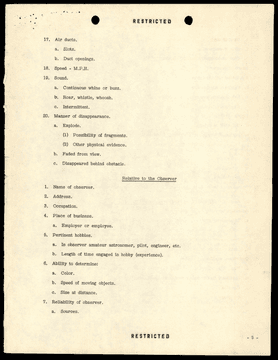
PAGE 44

form

This page is a continuation of a reporting form or questionnaire detailing the specific characteristics and data points to be recorded when documenting a UAP sighting.

RESTRICTED

b. Air
(1) Type aircraft, speed, altitude, direction of flight.
(2) Distance and direction from city, town or known landmark.
(3) Clock position of object from observer's aircraft.
(4) Latitude and longitude.
c. Sea
(1) Latitude and longitude.
(2) Proximity to land. (Name city, country, etc.)
4. Number of objects.
Formation type (if any), sketch if possible.
5. Observable celestial phenomena or planets that may account for the sighting. (Local facilities or organizations which follow such celestial phenomena should be consulted for such information.)
6. Distance of object from observer.
a. Laterally or horizontally.
b. Angle of elevation from horizon.
c. Altitude.
7. Time in sight.
8. Appearance of object.
a. Color.
b. Shape. (Sketch if possible)
c. Apparent construction. (Of what material or substance)
d. Size.
(1) Estimated size.
(2) Size as it appeared from observer's view. (Compared to known object)
9. Direction of flight.
10. Tactics or maneuvers.
Vertical ascent or descent, horizontal, oscillating, fluttering, evasive, aggressive, erratic, etc.
11. Evidence of exhaust.
a. Color of smoke.
b. Length and width.

RESTRICTED - 3 -

PAGE 45

form

This page is a continuation of a questionnaire or reporting form regarding the observation of aerial phenomena, specifically listing categories for physical characteristics like cloud effects, lights, support mechanisms, propulsion, and control surfaces.

RESTRICTED

c. Odor (if any).
d. Rate of evaporation.
e. Does trail vary with sound? (spurts)
12. Effect on clouds.
a. Opened path thru clouds.
b. Forced cloud or mists.
c. Reflected on cloud.
d. Showed thru cloud.
13. Lights.
a. Reflected or attached.
b. Luminous
c. Blinked on and off in relation to speed.
14. Support
a. Wings.
b. Aerodynamic list of fuselage.
c. Vertical jet.
d. Rotating cylinder or cone.
e. Aerostatic lift (balloon or dirigible).
15. Propulsion.
a. Propeller or jet.
b. Rotor.
c. Aerodynamic vanes (flapping or oscillating) (Katz Mayer effect).
d. Visible exhaust or jet openings.
16. Control and stability.
a. Fins
b. Stabilizers (horizontal or vertical).
(1) Size.
(2) Shape.
(3) Location.
- 4 - RESTRICTED

PAGE 46

form

This page is a continuation of a questionnaire or reporting form, listing criteria for describing air ducts, sound, manner of disappearance, and observer background information.

RESTRICTED

17. Air ducts.
   a. Slots.
   b. Duct openings.
18. Speed - M.P.H.
19. Sound.
   a. Continuous whine or buzz.
   b. Roar, whistle, whoosh.
   c. Intermittent.
20. Manner of disappearance.
   a. Explode.
      (1) Possibility of fragments.
      (2) Other physical evidence.
   b. Faded from view.
   c. Disappeared behind obstacle.

Relative to the Observer

1. Name of observer.
2. Address.
3. Occupation.
4. Place of business.
   a. Employer or employee.
5. Pertinent hobbies.
   a. Is observer amateur astronomer, pilot, engineer, etc.
   b. Length of time engaged in hobby (experience).
6. Ability to determine:
   a. Color.
   b. Speed of moving objects.
   c. Size at distance.
7. Reliability of observer.
   a. Sources.

RESTRICTED
- 5 -

PAGE 47

form

This page is a continuation of a questionnaire or reporting form regarding UFO/UAP sightings, specifically outlining criteria for observer notes, witness reliability, radar sightings, and general meteorological data.

RESTRICTED

(1) Neighbors.
(2) Police Dept.
(3) FBI records.
(4) Employer.
8. Notes relative to observer on:
a. Sightings in general.
b. How attention was drawn to object(s).
(1) Sound.
(2) Motion.
(3) Glint of light.
c. Degree of fatigue and duration of flight at time of sighting in cases where observer is airborne.
9. Witnesses.
a. Addressees.
b. Occupation.
c. Reliability.
10. Comments of interrogator regarding the intelligence and character of person interrogated.

Relative to Radar Sightings

1. Re radars operating on ground.
a. Observations of range, speed, altitude and size of target.
b. Did target executive any turns? If so, what angle (180o), etc. and what radius of turn. If radius of turn is not observable, how long did the target stay in the turn and what was its speed?
c. Note particularly any separation of distant target into several targets upon approach. Track all if possible.
2. If airborne when object sighted.
a. Were there any radar inductions or extra noise on radio circuits?
b. Give estimates of size, speed, maneuvers, etc.

GENERAL

1. Teletype sequences of local weather conditions.
2. Winds aloft report.

- 6 - RESTRICTED

PAGE 48

memo

This page outlines specific investigative instructions for reporting unidentified aerial objects, including checking flight schedules, testing for radioactivity, obtaining physical evidence, and documenting observations through photographs or sketches.

RESTRICTED

3. Local flight schedules of commercial, private and military aircraft flying in vicinity at the time. (Check Canadian activity if close to that border.)

4. Possible releases of testing devices in vicinity sent aloft by Ordnance, Navy, Air Force, Army, Weather Units, Research Organizations or any other.

5. If object contacted earth, obtain soil samples within and without depression or spot where object landed (and then presumably departed) for purpose of making comparison of soils.

6. If object came sufficiently near other aircraft or known objects check surfaces with Geiger counters for possible radioactivity. Make comparisons with other unaffected aircraft objects, etc.

7. Obtain photographs (or original negatives) where available; if not, secure sketches of:

a. Object.

b. Surrounding terrain where observed.

c. Place where it contacted earth (if this happened).

d. Maneuvers.

e. Formation if objects were more than two.

8. Secure signed statement.

9. Obtain fragments or physical evidence where possible.

10. Was any radio antenna to be observed, i.e., (any projections or extentions that might presumably be construed as such).

C. P. CABELL
C. P. CABELL
Major General, USAF
Director of Intelligence, Office of
Deputy Chief of Staff, Operations

DISTRIBUTION:

Commanding Generals, Major Air Commands,
ZI and Overseas
All United States Air Attaches

Director of Central Intelligence
Special Assistant for Research and Intelligence,
Department of State
Director of Intelligence, GSUSA
Chief of Naval Intelligence
Commandant (INT), United States Coast Guard
Director, Federal Bureau of Investigation

RESTRICTED
- 7 -

PAGE 49

PAGE 50

memo

This memorandum from the Department of the Air Force outlines requirements and procedures for reporting sightings of unconventional aircraft and unidentified flying objects.

RESTRICTED

DEPARTMENT OF THE AIR FORCE
HEADQUARTERS UNITED STATES AIR FORCE
DIRECTORATE OF INTELLIGENCE
WASHINGTON 25, D. C.

15 February 1949

AIR INTELLIGENCE REQUIREMENTS
MEMORANDUM NUMBER 4

UNCONVENTIONAL AIRCRAFT

PART I - GENERAL

1. PURPOSE

The purpose of this memorandum is twofold:

a. To enunciate continuing Air Force requirements for information pertaining to sightings of unconventional aircraft and unidentified flying objects, including the so-called "Flying Discs."

b. To establish procedures for reporting such information.

2. RESCISSION

Department of the Army Collection Memorandum Number 7, dated 21 January 1948, and letter, CSGID 425.1, dated 25 March 1948, both subject as above, which have been transferred to Air Force agencies for action, are herewith superseded.

3. REPORTING

a. General

(1) As complete an answer to the requirements enunciated in Part II, as may be procurable, should be dispatched by means of electrical transmission immediately after sightings.

(2) Supplementary reports should be forwarded as available by the most expeditious means consistent with the importance of the information reported.

b. Major Air Commands (Overseas) and Air Attaches

(1) Initial and supplementary cabled reports will be transmitted to the Director of Intelligence, Headquarters United States Air Force. Cables will contain the phase, "Pass to COMGENAMC WRIGHT-PATTERSON AFB, DAYTON, OHIO, ATTN: MCIAXO-3."

RESTRICTED
C9-4892, AF
[HANDWRITTEN: 65- 83894-164]

PAGE 51

report

This page outlines reporting procedures for UAP sightings, specifying that reports should be sent to the Air Materiel Command at Wright-Patterson Air Force Base and detailing the required information for such reports.

RESTRICTED

(2) Supplementary written reports, prepared on AF Form 112, will be forwarded to the Director of Intelligence, Headquarters United States Air Force.

(3) Commanding General, Air Materiel Command is authorized direct contact with major Air Commands (overseas) and organizations under their control in connection with the development of information on this subject.

c. Major Air Commands (ZI)

(1) Reports will be forwarded direct to the Commanding General, Air Materiel Command, Wright-Patterson Air Force Base, Dayton, Ohio, Attn: MCIAXO-3 by installations receiving information pertaining to the requirements enunciated in Part II.

(2) Copies of such reports may be supplied the Command Headquarters of the installation concerned.

(3) A copy of all reports sent to Air Materiel Command in accordance with these instructions will be forwarded at the same time to the Director of Intelligence, Headquarters United States Air Force.

(4) Written reports will be submitted on AF Form 112.

(5) Commanding General, Air Materiel Command is authorized direct contact with major Air Commands (ZI) and organizations under their control in connection with the development of information on this subject.

d. Non-Air Force Agencies

(1) Addressees other than those of the United States Air Force are requested to forward reports direct to the Commanding General, Air Materiel Command, Wright-Patterson Air Force Base, Dayton, Ohio, Attn: MCIAXO-3.

(2) In order to reduce the time factor involved in transmission of this type of information it is requested that, wherever communications facilities permit, subordinate elements be authorized to communicate reports direct to the Commanding General, Air Materiel Command.

PART II - REQUIREMENTS

General

1. Date of sighting.

2. Time of sighting (zonal by 24 hr. clock).

3. Where sighted (observer's position):

a. Ground

(1) City, town.

(2) Distance and direction from city or town, road, intersection, etc.

(3) From building (story), yard, etc.

(4) Map coordinates (if feasible) showing latitude and longitude.

- 2 - RESTRICTED
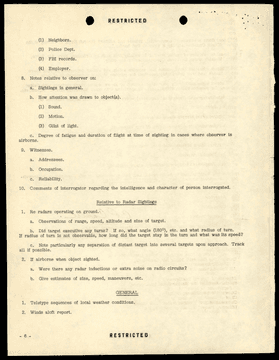
PAGE 52

form

This page is a continuation of a reporting form for unidentified aerial phenomena, listing specific data points to be collected regarding the sighting, such as object appearance, flight characteristics, and environmental context.

RESTRICTED

b. Air
(1) Type aircraft, speed, altitude, direction of flight.
(2) Distance and direction from city, town or known landmark.
(3) Clock position of object from observer's aircraft.
(4) Latitude and longitude.
c. Sea
(1) Latitude and longitude.
(2) Proximity to land. (Name city, country, etc.)
4. Number of objects.
Formation type (if any), sketch if possible.
5. Observable celestial phenomena or planets that may account for the sighting. (Local facilities or organizations which follow such celestial phenomena should be consulted for such information.)
6. Distance of object from observer.
a. Laterally or horizontally.
b. Angle of elevation from horizon.
c. Altitude.
7. Time in sight.
8. Appearance of object.
a. Color.
b. Shape. (Sketch if possible)
c. Apparent construction. (Of what material or substance)
d. Size.
(1) Estimated size.
(2) Size as it appeared from observer's view. (Compared to known object)
9. Direction of flight.
10. Tactics or maneuvers.
Vertical ascent or descent, horizontal, oscillating, fluttering, evasive, aggressive, erratic, etc.
11. Evidence of exhaust.
a. Color of smoke.
b. Length and width.
RESTRICTED - 3 -

PAGE 53

report

This page is a continuation of a technical checklist or questionnaire used to categorize observations of unidentified aerial phenomena, specifically focusing on physical effects, lighting, support mechanisms, propulsion, and control surfaces.

RESTRICTED

c. Odor (if any).
d. Rate of evaporation.
e. Does trail vary with sound? (spurts)
12. Effect on clouds.
a. Opened path thru clouds.
b. Forced cloud or mists.
c. Reflected on cloud.
d. Showed thru cloud.
13. Lights.
a. Reflected or attached.
b. Luminous
c. Blinked on and off in relation to speed.
14. Support
a. Wings.
b. Aerodynamic list of fuselage.
c. Vertical jet.
d. Rotating cylinder or cone.
e. Aerostatic lift (balloon or dirigible).
15. Propulsion.
a. Propeller or jet.
b. Rotor.
c. Aerodynamic vanes (flapping or oscillating) (Katz Mayer effect).
d. Visible exhaust or jet openings.
16. Control and stability.
a. Fins
b. Stabilizers (horizontal or vertical).
(1) Size.
(2) Shape.
(3) Location.
- 4 - RESTRICTED

PAGE 54

form

This page is a continuation of a questionnaire or reporting form, listing criteria for describing UAP characteristics (air ducts, speed, sound, disappearance) and observer background information.

RESTRICTED

17. Air ducts.
    a. Slots.
    b. Duct openings.
18. Speed - M.P.H.
19. Sound.
    a. Continuous whine or buzz.
    b. Roar, whistle, whoosh.
    c. Intermittent.
20. Manner of disappearance.
    a. Explode.
        (1) Possibility of fragments.
        (2) Other physical evidence.
    b. Faded from view.
    c. Disappeared behind obstacle.

Relative to the Observer

1. Name of observer.
2. Address.
3. Occupation.
4. Place of business.
    a. Employer or employee.
5. Pertinent hobbies.
    a. Is observer amateur astronomer, pilot, engineer, etc.
    b. Length of time engaged in hobby (experience).
6. Ability to determine:
    a. Color.
    b. Speed of moving objects.
    c. Size at distance.
7. Reliability of observer.
    a. Sources.

RESTRICTED
- 5 -

PAGE 55

form

This page is a continuation of a questionnaire or reporting form for UFO/UAP sightings, outlining specific categories for observer notes, witness details, radar sighting data, and general meteorological information.

RESTRICTED

(1) Neighbors.
(2) Police Dept.
(3) FBI records.
(4) Employer.
8. Notes relative to observer on:
a. Sightings in general.
b. How attention was drawn to object(s).
(1) Sound.
(2) Motion.
(3) Glint of light.
c. Degree of fatigue and duration of flight at time of sighting in cases where observer is airborne.
9. Witnesses.
a. Addressees.
b. Occupation.
c. Reliability.
10. Comments of interrogator regarding the intelligence and character of person interrogated.

Relative to Radar Sightings
1. Re radars operating on ground.
a. Observations of range, speed, altitude and size of target.
b. Did target executive any turns? If so, what angle (180°), etc. and what radius of turn. If radius of turn is not observable, how long did the target stay in the turn and what was its speed?
c. Note particularly any separation of distant target into several targets upon approach. Track all if possible.
2. If airborne when object sighted.
a. Were there any radar inductions or extra noise on radio circuits?
b. Give estimates of size, speed, maneuvers, etc.

GENERAL
1. Teletype sequences of local weather conditions.
2. Winds aloft report.

- 6 - RESTRICTED

PAGE 56

memo

This page outlines specific investigative procedures for reporting and documenting unidentified aerial objects, including soil sampling, radiation checks, and photographic evidence, signed by Major General C. P. Cabell.

RESTRICTED

3. Local flight schedules of commercial, private and military aircraft flying in vicinity at the time. (Check Canadian activity if close to that border.)

4. Possible releases of testing devices in vicinity sent aloft by Ordnance, Navy, Air Force, Army, Weather Units, Research Organizations or any other.

5. If object contacted earth, obtain soil samples within and without depression or spot where object landed (and then presumably departed) for purpose of making comparison of soils.

6. If object came sufficiently near other aircraft or known objects check surfaces with Geiger counters for possible radioactivity. Make comparisons with other unaffected aircraft objects, etc.

7. Obtain photographs (or original negatives) where available; if not, secure sketches of:

a. Object.

b. Surrounding terrain where observed.

c. Place where it contacted earth (if this happened).

d. Maneuvers.

e. Formation if objects were more than two.

8. Secure signed statement.

9. Obtain fragments or physical evidence where possible.

10. Was any radio antenna to be observed, i.e., (any projections or extentions that might presumably be construed as such).

[HANDWRITTEN: C. P. Cabell]
C. P. CABELL
Major General, USAF
Director of Intelligence, Office of
Deputy Chief of Staff, Operations

DISTRIBUTION:

Commanding Generals, Major Air Commands,
ZI and Overseas
All United States Air Attaches

Director of Central Intelligence
Special Assistant for Research and Intelligence,
Department of State
Director of Intelligence, GSUSA
Chief of Naval Intelligence
Commandant (INT), United States Coast Guard
Director, Federal Bureau of Investigation

RESTRICTED
- 7 -

PAGE 57

PAGE 58

memo

This is Air Intelligence Requirements Memorandum Number 4, dated February 15, 1949, regarding reporting procedures for sightings of unconventional aircraft and unidentified flying objects.

RESTRICTED

DEPARTMENT OF THE AIR FORCE
HEADQUARTERS UNITED STATES AIR FORCE
DIRECTORATE OF INTELLIGENCE
WASHINGTON 25, D. C.

15 February 1949

AIR INTELLIGENCE REQUIREMENTS
MEMORANDUM NUMBER 4

UNCONVENTIONAL AIRCRAFT

PART I - GENERAL

1. PURPOSE

The purpose of this memorandum is twofold:

a. To enunciate continuing Air Force requirements for information pertaining to sightings of unconventional aircraft and unidentified flying objects, including the so-called "Flying Discs."

b. To establish procedures for reporting such information.

2. RESCISSION

Department of the Army Collection Memorandum Number 7, dated 21 January 1948, and letter, CSGID 425.1, dated 25 March 1948, both subject as above, which have been transferred to Air Force agencies for action, are herewith superseded.

3. REPORTING

a. General

(1) As complete an answer to the requirements enunciated in Part II, as may be procurable, should be dispatched by means of electrical transmission immediately after sightings.

(2) Supplementary reports should be forwarded as available by the most expeditious means consistent with the importance of the information reported.

b. Major Air Commands (Overseas) and Air Attaches

(1) Initial and supplementary cabled reports will be transmitted to the Director of Intelligence, Headquarters United States Air Force. Cables will contain the phase, "Pass to COMGENAMC WRIGHT-PATTERSON AFB, DAYTON, OHIO, ATTN: MCIAXO-3."

RESTRICTED
C9-4892,AF
[HANDWRITTEN: 65-83894-164]

PAGE 59

report

This page outlines reporting procedures for Air Force and non-Air Force agencies regarding sightings, including specific instructions for forwarding reports to the Air Materiel Command and the required information for Part II (Requirements).

RESTRICTED

(2) Supplementary written reports, prepared on AF Form 112, will be forwarded to the Director of Intelligence, Headquarters United States Air Force.

(3) Commanding General, Air Materiel Command is authorized direct contact with major Air Commands (overseas) and organizations under their control in connection with the development of information on this subject.

c. Major Air Commands (ZI)

(1) Reports will be forwarded direct to the Commanding General, Air Materiel Command, Wright-Patterson Air Force Base, Dayton, Ohio, Attn: MCIAXO-3 by installations receiving information pertaining to the requirements enunciated in Part II.

(2) Copies of such reports may be supplied the Command Headquarters of the installation concerned.

(3) A copy of all reports sent to Air Materiel Command in accordance with these instructions will be forwarded at the same time to the Director of Intelligence, Headquarters United States Air Force.

(4) Written reports will be submitted on AF Form 112.

(5) Commanding General, Air Materiel Command is authorized direct contact with major Air Commands (ZI) and organizations under their control in connection with the development of information on this subject.

d. Non-Air Force Agencies

(1) Addressees other than those of the United States Air Force are requested to forward reports direct to the Commanding General, Air Materiel Command, Wright-Patterson Air Force Base, Dayton, Ohio, Attn: MCIAXO-3.

(2) In order to reduce the time factor involved in transmission of this type of information it is requested that, wherever communications facilities permit, subordinate elements be authorized to communicate reports direct to the Commanding General, Air Materiel Command.

PART II - REQUIREMENTS

General

1. Date of sighting.

2. Time of sighting (zonal by 24 hr. clock).

3. Where sighted (observer's position):

a. Ground

(1) City, town.

(2) Distance and direction from city or town, road, intersection, etc.

(3) From building (story), yard, etc.

(4) Map coordinates (if feasible) showing latitude and longitude.

- 2 - RESTRICTED
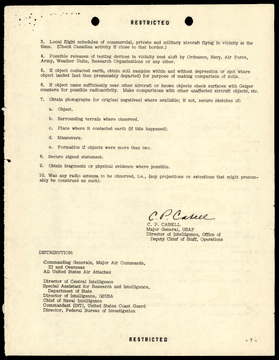
PAGE 60

report

This page is a continuation of a reporting form, listing specific criteria for documenting aerial and maritime sightings, including physical characteristics, maneuvers, and environmental context.

RESTRICTED

b. Air
(1) Type aircraft, speed, altitude, direction of flight.
(2) Distance and direction from city, town or known landmark.
(3) Clock position of object from observer's aircraft.
(4) Latitude and longitude.
c. Sea
(1) Latitude and longitude.
(2) Proximity to land. (Name city, country, etc.)
4. Number of objects.
Formation type (if any), sketch if possible.
5. Observable celestial phenomena or planets that may account for the sighting. (Local facilities or organizations which follow such celestial phenomena should be consulted for such information.)
6. Distance of object from observer.
a. Laterally or horizontally.
b. Angle of elevation from horizon.
c. Altitude.
7. Time in sight.
8. Appearance of object.
a. Color.
b. Shape. (Sketch if possible)
c. Apparent construction. (Of what material or substance)
d. Size.
(1) Estimated size.
(2) Size as it appeared from observer's view. (Compared to known object)
9. Direction of flight.
10. Tactics or maneuvers.
Vertical ascent or descent, horizontal, oscillating, fluttering, evasive, aggressive, erratic, etc.
11. Evidence of exhaust.
a. Color of smoke.
b. Length and width.

RESTRICTED - 3 -

PAGE 61

report

This page is a continuation of a technical questionnaire or checklist used to document observations of unidentified aerial phenomena, specifically focusing on physical characteristics like cloud interaction, lighting, support mechanisms, propulsion, and stability.

RESTRICTED

c. Odor (if any).
d. Rate of evaporation.
e. Does trail vary with sound? (spurts)
12. Effect on clouds.
a. Opened path thru clouds.
b. Forced cloud or mists.
c. Reflected on cloud.
d. Showed thru cloud.
13. Lights.
a. Reflected or attached.
b. Luminous.
c. Blinked on and off in relation to speed.
14. Support
a. Wings.
b. Aerodynamic list of fuselage.
c. Vertical jet.
d. Rotating cylinder or cone.
e. Aerostatic lift (balloon or dirigible).
15. Propulsion.
a. Propeller or jet.
b. Rotor.
c. Aerodynamic vanes (flapping or oscillating) (Katz Mayer effect).
d. Visible exhaust or jet openings.
16. Control and stability.
a. Fins
b. Stabilizers (horizontal or vertical).
(1) Size.
(2) Shape.
(3) Location.

- 4 - RESTRICTED

PAGE 62

form

This page is a continuation of a questionnaire or reporting form, listing criteria for describing observed phenomena and the observer's background.

RESTRICTED

17. Air ducts.
   a. Slots.
   b. Duct openings.
18. Speed - M.P.H.
19. Sound.
   a. Continuous whine or buzz.
   b. Roar, whistle, whoosh.
   c. Intermittent.
20. Manner of disappearance.
   a. Explode.
      (1) Possibility of fragments.
      (2) Other physical evidence.
   b. Faded from view.
   c. Disappeared behind obstacle.

Relative to the Observer

1. Name of observer.
2. Address.
3. Occupation.
4. Place of business.
   a. Employer or employee.
5. Pertinent hobbies.
   a. Is observer amateur astronomer, pilot, engineer, etc.
   b. Length of time engaged in hobby (experience).
6. Ability to determine:
   a. Color.
   b. Speed of moving objects.
   c. Size at distance.
7. Reliability of observer.
   a. Sources.

RESTRICTED
- 5 -

PAGE 63

form

This page is a continuation of a questionnaire or reporting form regarding UFO/UAP sightings, specifically detailing sections for observer notes, witness information, radar sighting criteria, and general weather reporting requirements.

RESTRICTED

(1) Neighbors.
(2) Police Dept.
(3) FBI records.
(4) Employer.
8. Notes relative to observer on:
a. Sightings in general.
b. How attention was drawn to object(s).
(1) Sound.
(2) Motion.
(3) Glint of light.
c. Degree of fatigue and duration of flight at time of sighting in cases where observer is airborne.
9. Witnesses.
a. Addressees.
b. Occupation.
c. Reliability.
10. Comments of interrogator regarding the intelligence and character of person interrogated.

Relative to Radar Sightings

1. Re radars operating on ground.
a. Observations of range, speed, altitude and size of target.
b. Did target executive any turns? If so, what angle (180°), etc. and what radius of turn. If radius of turn is not observable, how long did the target stay in the turn and what was its speed?
c. Note particularly any separation of distant target into several targets upon approach. Track all if possible.
2. If airborne when object sighted.
a. Were there any radar inductions or extra noise on radio circuits?
b. Give estimates of size, speed, maneuvers, etc.

GENERAL

1. Teletype sequences of local weather conditions.
2. Winds aloft report.

- 6 - RESTRICTED

PAGE 64

memo

This page outlines specific investigative procedures for reporting unidentified aerial objects, including collecting soil samples, checking for radioactivity, and obtaining photographic or physical evidence, signed by Major General C. P. Cabell.

RESTRICTED

3. Local flight schedules of commercial, private and military aircraft flying in vicinity at the time. (Check Canadian activity if close to that border.)

4. Possible releases of testing devices in vicinity sent aloft by Ordnance, Navy, Air Force, Army, Weather Units, Research Organizations or any other.

5. If object contacted earth, obtain soil samples within and without depression or spot where object landed (and then presumably departed) for purpose of making comparison of soils.

6. If object came sufficiently near other aircraft or known objects check surfaces with Geiger counters for possible radioactivity. Make comparisons with other unaffected aircraft objects, etc.

7. Obtain photographs (or original negatives) where available; if not, secure sketches of:

a. Object.

b. Surrounding terrain where observed.

c. Place where it contacted earth (if this happened).

d. Maneuvers.

e. Formation if objects were more than two.

8. Secure signed statement.

9. Obtain fragments or physical evidence where possible.

10. Was any radio antenna to be observed, i.e., (any projections or extentions that might presumably be construed as such).

C. P. CABELL
Major General, USAF
Director of Intelligence, Office of
Deputy Chief of Staff, Operations

DISTRIBUTION:

Commanding Generals, Major Air Commands,
ZI and Overseas
All United States Air Attaches

Director of Central Intelligence
Special Assistant for Research and Intelligence,
Department of State
Director of Intelligence, GSUSA
Chief of Naval Intelligence
Commandant (INT), United States Coast Guard
Director, Federal Bureau of Investigation

RESTRICTED
- 7 -

PAGE 65

PAGE 66

memo

This is Air Intelligence Requirements Memorandum Number 4, dated February 15, 1949, regarding reporting procedures for sightings of unconventional aircraft and unidentified flying objects.

RESTRICTED

DEPARTMENT OF THE AIR FORCE
HEADQUARTERS UNITED STATES AIR FORCE
DIRECTORATE OF INTELLIGENCE
WASHINGTON 25, D. C.

15 February 1949

AIR INTELLIGENCE REQUIREMENTS
MEMORANDUM NUMBER 4

UNCONVENTIONAL AIRCRAFT

PART I - GENERAL

1. PURPOSE

The purpose of this memorandum is twofold:

a. To enunciate continuing Air Force requirements for information pertaining to sightings of unconventional aircraft and unidentified flying objects, including the so-called "Flying Discs."

b. To establish procedures for reporting such information.

2. RESCISSION

Department of the Army Collection Memorandum Number 7, dated 21 January 1948, and letter, CSGID 425.1, dated 25 March 1948, both subject as above, which have been transferred to Air Force agencies for action, are herewith superseded.

3. REPORTING

a. General

(1) As complete an answer to the requirements enunciated in Part II, as may be procurable, should be dispatched by means of electrical transmission immediately after sightings.

(2) Supplementary reports should be forwarded as available by the most expeditious means consistent with the importance of the information reported.

b. Major Air Commands (Overseas) and Air Attaches

(1) Initial and supplementary cabled reports will be transmitted to the Director of Intelligence, Headquarters United States Air Force. Cables will contain the phase, "Pass to COMGENAMC WRIGHT-PATTERSON AFB, DAYTON, OHIO, ATTN: MCIAXO-3."

RESTRICTED
C9-4892, AF
[HANDWRITTEN: 65-83894-164]

PAGE 67

memo

This document outlines the reporting procedures for UAP/UFO sightings, specifying that reports should be sent to the Air Materiel Command at Wright-Patterson Air Force Base using AF Form 112, and lists the required information for such reports.

RESTRICTED

(2) Supplementary written reports, prepared on AF Form 112, will be forwarded to the Director of Intelligence, Headquarters United States Air Force.

(3) Commanding General, Air Materiel Command is authorized direct contact with major Air Commands (overseas) and organizations under their control in connection with the development of information on this subject.

c. Major Air Commands (ZI)

(1) Reports will be forwarded direct to the Commanding General, Air Materiel Command, Wright-Patterson Air Force Base, Dayton, Ohio, Attn: MCIAXO-3 by installations receiving information pertaining to the requirements enunciated in Part II.

(2) Copies of such reports may be supplied the Command Headquarters of the installation concerned.

(3) A copy of all reports sent to Air Materiel Command in accordance with these instructions will be forwarded at the same time to the Director of Intelligence, Headquarters United States Air Force.

(4) Written reports will be submitted on AF Form 112.

(5) Commanding General, Air Materiel Command is authorized direct contact with major Air Commands (ZI) and organizations under their control in connection with the development of information on this subject.

d. Non-Air Force Agencies

(1) Addressees other than those of the United States Air Force are requested to forward reports direct to the Commanding General, Air Materiel Command, Wright-Patterson Air Force Base, Dayton, Ohio, Attn: MCIAXO-3.

(2) In order to reduce the time factor involved in transmission of this type of information it is requested that, wherever communications facilities permit, subordinate elements be authorized to communicate reports direct to the Commanding General, Air Materiel Command.

PART II - REQUIREMENTS

General

1. Date of sighting.
2. Time of sighting (zonal by 24 hr. clock).
3. Where sighted (observer's position):

a. Ground
(1) City, town.
(2) Distance and direction from city or town, road, intersection, etc.
(3) From building (story), yard, etc.
(4) Map coordinates (if feasible) showing latitude and longitude.

- 2 - RESTRICTED
PAGE 68

form

This page is a continuation of a reporting form, listing specific criteria for documenting sightings of aerial or maritime objects, including physical characteristics, maneuvers, and environmental context.

RESTRICTED

b. Air
(1) Type aircraft, speed, altitude, direction of flight.
(2) Distance and direction from city, town or known landmark.
(3) Clock position of object from observer's aircraft.
(4) Latitude and longitude.
c. Sea
(1) Latitude and longitude.
(2) Proximity to land. (Name city, country, etc.)
4. Number of objects.
Formation type (if any), sketch if possible.
5. Observable celestial phenomena or planets that may account for the sighting. (Local facilities or organizations which follow such celestial phenomena should be consulted for such information.)
6. Distance of object from observer.
a. Laterally or horizontally.
b. Angle of elevation from horizon.
c. Altitude.
7. Time in sight.
8. Appearance of object.
a. Color.
b. Shape. (Sketch if possible)
c. Apparent construction. (Of what material or substance)
d. Size.
(1) Estimated size.
(2) Size as it appeared from observer's view. (Compared to known object)
9. Direction of flight.
10. Tactics or maneuvers.
Vertical ascent or descent, horizontal, oscillating, fluttering, evasive, aggressive, erratic, etc.
11. Evidence of exhaust.
a. Color of smoke.
b. Length and width.

RESTRICTED
- 3 -

PAGE 69

report

This page is a continuation of a technical questionnaire or checklist used to document observations of unidentified aerial phenomena, specifically focusing on physical characteristics like cloud interaction, lighting, support mechanisms, propulsion, and control surfaces.

RESTRICTED

c. Odor (if any).
d. Rate of evaporation.
e. Does trail vary with sound? (spurts)
12. Effect on clouds.
a. Opened path thru clouds.
b. Forced cloud or mists.
c. Reflected on cloud.
d. Showed thru cloud.
13. Lights.
a. Reflected or attached.
b. Luminous.
c. Blinked on and off in relation to speed.
14. Support
a. Wings.
b. Aerodynamic list of fuselage.
c. Vertical jet.
d. Rotating cylinder or cone.
e. Aerostatic lift (balloon or dirigible).
15. Propulsion.
a. Propeller or jet.
b. Rotor.
c. Aerodynamic vanes (flapping or oscillating) (Katz Mayer effect).
d. Visible exhaust or jet openings.
16. Control and stability.
a. Fins
b. Stabilizers (horizontal or vertical).
(1) Size.
(2) Shape.
(3) Location.

- 4 - RESTRICTED

PAGE 70

form

This page is a continuation of a questionnaire or reporting form for UFO/UAP sightings, listing technical characteristics of the object and criteria for evaluating the observer.

RESTRICTED

17. Air ducts.
a. Slots.
b. Duct openings.
18. Speed - M.P.H.
19. Sound.
a. Continuous whine or buzz.
b. Roar, whistle, whoosh.
c. Intermittent.
20. Manner of disappearance.
a. Explode.
(1) Possibility of fragments.
(2) Other physical evidence.
b. Faded from view.
c. Disappeared behind obstacle.

Relative to the Observer

1. Name of observer.
2. Address.
3. Occupation.
4. Place of business.
a. Employer or employee.
5. Pertinent hobbies.
a. Is observer amateur astronomer, pilot, engineer, etc.
b. Length of time engaged in hobby (experience).
6. Ability to determine:
a. Color.
b. Speed of moving objects.
c. Size at distance.
7. Reliability of observer.
a. Sources.

RESTRICTED
- 5 -

PAGE 71

form

This page is a continuation of a questionnaire or reporting form outlining criteria for evaluating UFO/UAP sightings, including observer notes, witness reliability, radar observations, and general weather data.

RESTRICTED

(1) Neighbors.
(2) Police Dept.
(3) FBI records.
(4) Employer.
8. Notes relative to observer on:
a. Sightings in general.
b. How attention was drawn to object(s).
(1) Sound.
(2) Motion.
(3) Glint of light.
c. Degree of fatigue and duration of flight at time of sighting in cases where observer is airborne.
9. Witnesses.
a. Addressees.
b. Occupation.
c. Reliability.
10. Comments of interrogator regarding the intelligence and character of person interrogated.

Relative to Radar Sightings
1. Re radars operating on ground.
a. Observations of range, speed, altitude and size of target.
b. Did target executive any turns? If so, what angle (180°), etc. and what radius of turn. If radius of turn is not observable, how long did the target stay in the turn and what was its speed?
c. Note particularly any separation of distant target into several targets upon approach. Track all if possible.
2. If airborne when object sighted.
a. Were there any radar inductions or extra noise on radio circuits?
b. Give estimates of size, speed, maneuvers, etc.

GENERAL
1. Teletype sequences of local weather conditions.
2. Winds aloft report.

- 6 - RESTRICTED

PAGE 72

memo

This page outlines specific investigative procedures for reporting and documenting unidentified aerial objects, including soil sampling, radiation checks, and photographic evidence, signed by Major General C. P. Cabell.

RESTRICTED

3. Local flight schedules of commercial, private and military aircraft flying in vicinity at the time. (Check Canadian activity if close to that border.)

4. Possible releases of testing devices in vicinity sent aloft by Ordnance, Navy, Air Force, Army, Weather Units, Research Organizations or any other.

5. If object contacted earth, obtain soil samples within and without depression or spot where object landed (and then presumably departed) for purpose of making comparison of soils.

6. If object came sufficiently near other aircraft or known objects check surfaces with Geiger counters for possible radioactivity. Make comparisons with other unaffected aircraft objects, etc.

7. Obtain photographs (or original negatives) where available; if not, secure sketches of:

a. Object.

b. Surrounding terrain where observed.

c. Place where it contacted earth (if this happened).

d. Maneuvers.

e. Formation if objects were more than two.

8. Secure signed statement.

9. Obtain fragments or physical evidence where possible.

10. Was any radio antenna to be observed, i.e., (any projections or extentions that might presumably be construed as such).

C. P. CABELL
Major General, USAF
Director of Intelligence, Office of
Deputy Chief of Staff, Operations

DISTRIBUTION:

Commanding Generals, Major Air Commands,
ZI and Overseas
All United States Air Attaches

Director of Central Intelligence
Special Assistant for Research and Intelligence,
Department of State
Director of Intelligence, GSUSA
Chief of Naval Intelligence
Commandant (INT), United States Coast Guard
Director, Federal Bureau of Investigation

RESTRICTED
- 7 -

PAGE 73

blank

This is a blank page with only the word RESTRICTED printed at the top and bottom.

RESTRICTED

RESTRICTED

PAGE 74

memo

This is an Air Intelligence Requirements Memorandum (Number 4) from the Department of the Air Force, dated February 15, 1949, establishing procedures for reporting sightings of unconventional aircraft and unidentified flying objects.

RESTRICTED

DEPARTMENT OF THE AIR FORCE
HEADQUARTERS UNITED STATES AIR FORCE
DIRECTORATE OF INTELLIGENCE
WASHINGTON 25, D. C.

15 February 1949

AIR INTELLIGENCE REQUIREMENTS
MEMORANDUM NUMBER 4

UNCONVENTIONAL AIRCRAFT

PART I - GENERAL

1. PURPOSE

The purpose of this memorandum is twofold:

a. To enunciate continuing Air Force requirements for information pertaining to sightings of unconventional aircraft and unidentified flying objects, including the so-called "Flying Discs."

b. To establish procedures for reporting such information.

2. RESCISSION

Department of the Army Collection Memorandum Number 7, dated 21 January 1948, and letter, CSGID 425.1, dated 25 March 1948, both subject as above, which have been transferred to Air Force agencies for action, are herewith superseded.

3. REPORTING

a. General

(1) As complete an answer to the requirements enunciated in Part II, as may be procurable, should be dispatched by means of electrical transmission immediately after sightings.

(2) Supplementary reports should be forwarded as available by the most expeditious means consistent with the importance of the information reported.

b. Major Air Commands (Overseas) and Air Attaches

(1) Initial and supplementary cabled reports will be transmitted to the Director of Intelligence, Headquarters United States Air Force. Cables will contain the phase, "Pass to COMGENAMC WRIGHT-PATTERSON AFB, DAYTON, OHIO, ATTN: MCIAXO-3."

RESTRICTED
C9-4892, AF
[HANDWRITTEN: 65-83894-164]

PAGE 75

memo

This document outlines the reporting procedures for UAP/UFO sightings, specifying that reports should be submitted on AF Form 112 to the Air Materiel Command at Wright-Patterson Air Force Base, and details the required information for such reports.

RESTRICTED

(2) Supplementary written reports, prepared on AF Form 112, will be forwarded to the Director of Intelligence, Headquarters United States Air Force.

(3) Commanding General, Air Materiel Command is authorized direct contact with major Air Commands (overseas) and organizations under their control in connection with the development of information on this subject.

c. Major Air Commands (ZI)

(1) Reports will be forwarded direct to the Commanding General, Air Materiel Command, Wright-Patterson Air Force Base, Dayton, Ohio, Attn: MCIAXO-3 by installations receiving information pertaining to the requirements enunciated in Part II.

(2) Copies of such reports may be supplied the Command Headquarters of the installation concerned.

(3) A copy of all reports sent to Air Materiel Command in accordance with these instructions will be forwarded at the same time to the Director of Intelligence, Headquarters United States Air Force.

(4) Written reports will be submitted on AF Form 112.

(5) Commanding General, Air Materiel Command is authorized direct contact with major Air Commands (ZI) and organizations under their control in connection with the development of information on this subject.

d. Non-Air Force Agencies

(1) Addressees other than those of the United States Air Force are requested to forward reports direct to the Commanding General, Air Materiel Command, Wright-Patterson Air Force Base, Dayton, Ohio, Attn: MCIAXO-3.

(2) In order to reduce the time factor involved in transmission of this type of information it is requested that, wherever communications facilities permit, subordinate elements be authorized to communicate reports direct to the Commanding General, Air Materiel Command.

PART II - REQUIREMENTS

General

1. Date of sighting.
2. Time of sighting (zonal by 24 hr. clock).
3. Where sighted (observer's position):

a. Ground
(1) City, town.
(2) Distance and direction from city or town, road, intersection, etc.
(3) From building (story), yard, etc.
(4) Map coordinates (if feasible) showing latitude and longitude.

- 2 - RESTRICTED
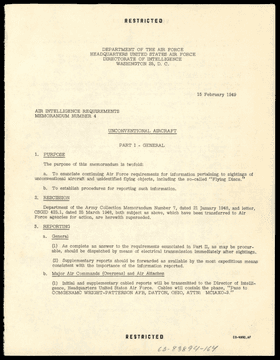
PAGE 76

other

This page is a continuation of a reporting form or instruction manual detailing the specific data points required when documenting a sighting of an unidentified object, including physical characteristics, location, and behavior.

RESTRICTED

b. Air
(1) Type aircraft, speed, altitude, direction of flight.
(2) Distance and direction from city, town or known landmark.
(3) Clock position of object from observer's aircraft.
(4) Latitude and longitude.
c. Sea
(1) Latitude and longitude.
(2) Proximity to land. (Name city, country, etc.)
4. Number of objects.
Formation type (if any), sketch if possible.
5. Observable celestial phenomena or planets that may account for the sighting. (Local facilities or organizations which follow such celestial phenomena should be consulted for such information.)
6. Distance of object from observer.
a. Laterally or horizontally.
b. Angle of elevation from horizon.
c. Altitude.
7. Time in sight.
8. Appearance of object.
a. Color.
b. Shape. (Sketch if possible)
c. Apparent construction. (Of what material or substance)
d. Size.
(1) Estimated size.
(2) Size as it appeared from observer's view. (Compared to known object)
9. Direction of flight.
10. Tactics or maneuvers.
Vertical ascent or descent, horizontal, oscillating, fluttering, evasive, aggressive, erratic, etc.
11. Evidence of exhaust.
a. Color of smoke.
b. Length and width.

RESTRICTED - 3 -

PAGE 77

form

This page is a continuation of a questionnaire or reporting form regarding the observation of unidentified aerial phenomena, specifically detailing categories for cloud effects, lights, support mechanisms, propulsion, and control/stability.

RESTRICTED

c. Odor (if any).
d. Rate of evaporation.
e. Does trail vary with sound? (spurts)
12. Effect on clouds.
a. Opened path thru clouds.
b. Forced cloud or mists.
c. Reflected on cloud.
d. Showed thru cloud.
13. Lights.
a. Reflected or attached.
b. Luminous
c. Blinked on and off in relation to speed.
14. Support
a. Wings.
b. Aerodynamic list of fuselage.
c. Vertical jet.
d. Rotating cylinder or cone.
e. Aerostatic lift (balloon or dirigible).
15. Propulsion.
a. Propeller or jet.
b. Rotor.
c. Aerodynamic vanes (flapping or oscillating) (Katz Mayer effect).
d. Visible exhaust or jet openings.
16. Control and stability.
a. Fins
b. Stabilizers (horizontal or vertical).
(1) Size.
(2) Shape.
(3) Location.

- 4 - RESTRICTED

PAGE 78

form

This page is a continuation of a questionnaire or reporting form for UFO/UAP sightings, listing technical characteristics of the object and criteria for evaluating the observer.

RESTRICTED

17. Air ducts.
   a. Slots.
   b. Duct openings.
18. Speed - M.P.H.
19. Sound.
   a. Continuous whine or buzz.
   b. Roar, whistle, whoosh.
   c. Intermittent.
20. Manner of disappearance.
   a. Explode.
      (1) Possibility of fragments.
      (2) Other physical evidence.
   b. Faded from view.
   c. Disappeared behind obstacle.

Relative to the Observer

1. Name of observer.
2. Address.
3. Occupation.
4. Place of business.
   a. Employer or employee.
5. Pertinent hobbies.
   a. Is observer amateur astronomer, pilot, engineer, etc.
   b. Length of time engaged in hobby (experience).
6. Ability to determine:
   a. Color.
   b. Speed of moving objects.
   c. Size at distance.
7. Reliability of observer.
   a. Sources.

RESTRICTED
- 5 -

PAGE 79

form

This page is a continuation of a questionnaire or reporting form regarding UFO/UAP sightings, specifically detailing requirements for observer notes, witness information, radar sighting data, and general meteorological data.

RESTRICTED

(1) Neighbors.
(2) Police Dept.
(3) FBI records.
(4) Employer.
8. Notes relative to observer on:
a. Sightings in general.
b. How attention was drawn to object(s).
(1) Sound.
(2) Motion.
(3) Glint of light.
c. Degree of fatigue and duration of flight at time of sighting in cases where observer is
airborne.
9. Witnesses.
a. Addressees.
b. Occupation.
c. Reliability.
10. Comments of interrogator regarding the intelligence and character of person interrogated.

Relative to Radar Sightings

1. Re radars operating on ground.
a. Observations of range, speed, altitude and size of target.
b. Did target executive any turns? If so, what angle (180o), etc. and what radius of turn.
If radius of turn is not observable, how long did the target stay in the turn and what was its speed?
c. Note particularly any separation of distant target into several targets upon approach. Track
all if possible.
2. If airborne when object sighted.
a. Were there any radar inductions or extra noise on radio circuits?
b. Give estimates of size, speed, maneuvers, etc.

GENERAL

1. Teletype sequences of local weather conditions.
2. Winds aloft report.

- 6 - RESTRICTED

PAGE 80

memo

This page outlines specific investigative procedures for reporting unidentified aerial objects, including checking flight schedules, testing for radioactivity, obtaining physical evidence, and documenting observations through photographs or sketches.

RESTRICTED

3. Local flight schedules of commercial, private and military aircraft flying in vicinity at the time. (Check Canadian activity if close to that border.)

4. Possible releases of testing devices in vicinity sent aloft by Ordnance, Navy, Air Force, Army, Weather Units, Research Organizations or any other.

5. If object contacted earth, obtain soil samples within and without depression or spot where object landed (and then presumably departed) for purpose of making comparison of soils.

6. If object came sufficiently near other aircraft or known objects check surfaces with Geiger counters for possible radioactivity. Make comparisons with other unaffected aircraft objects, etc.

7. Obtain photographs (or original negatives) where available; if not, secure sketches of:

a. Object.

b. Surrounding terrain where observed.

c. Place where it contacted earth (if this happened).

d. Maneuvers.

e. Formation if objects were more than two.

8. Secure signed statement.

9. Obtain fragments or physical evidence where possible.

10. Was any radio antenna to be observed, i.e., (any projections or extentions that might presumably be construed as such).

C. P. CABELL
C. P. CABELL
Major General, USAF
Director of Intelligence, Office of
Deputy Chief of Staff, Operations

DISTRIBUTION:

Commanding Generals, Major Air Commands,
ZI and Overseas
All United States Air Attaches

Director of Central Intelligence
Special Assistant for Research and Intelligence,
Department of State
Director of Intelligence, GSUSA
Chief of Naval Intelligence
Commandant (INT), United States Coast Guard
Director, Federal Bureau of Investigation

RESTRICTED
- 7 -

PAGE 81

blank

This is a blank page with the word RESTRICTED printed at the top and bottom.

RESTRICTED

RESTRICTED

PAGE 82

memo

This is Air Intelligence Requirements Memorandum Number 4, dated 15 February 1949, which outlines the purpose, rescission of previous orders, and reporting procedures for sightings of unconventional aircraft and unidentified flying objects.

RESTRICTED

DEPARTMENT OF THE AIR FORCE
HEADQUARTERS UNITED STATES AIR FORCE
DIRECTORATE OF INTELLIGENCE
WASHINGTON 25, D. C.

15 February 1949

AIR INTELLIGENCE REQUIREMENTS
MEMORANDUM NUMBER 4

UNCONVENTIONAL AIRCRAFT

PART I - GENERAL

1. PURPOSE

The purpose of this memorandum is twofold:

a. To enunciate continuing Air Force requirements for information pertaining to sightings of unconventional aircraft and unidentified flying objects, including the so-called "Flying Discs."

b. To establish procedures for reporting such information.

2. RESCISSION

Department of the Army Collection Memorandum Number 7, dated 21 January 1948, and letter, CSGID 425.1, dated 25 March 1948, both subject as above, which have been transferred to Air Force agencies for action, are herewith superseded.

3. REPORTING

a. General

(1) As complete an answer to the requirements enunciated in Part II, as may be procurable, should be dispatched by means of electrical transmission immediately after sightings.

(2) Supplementary reports should be forwarded as available by the most expeditious means consistent with the importance of the information reported.

b. Major Air Commands (Overseas) and Air Attaches

(1) Initial and supplementary cabled reports will be transmitted to the Director of Intelligence, Headquarters United States Air Force. Cables will contain the phase, "Pass to COMGENAMC WRIGHT-PATTERSON AFB, DAYTON, OHIO, ATTN: MCIAXO-3."

RESTRICTED
[HANDWRITTEN: 65- 83894-164]

PAGE 83

report

This page outlines the reporting procedures for UAP sightings, including instructions for Air Force and non-Air Force agencies to forward reports to the Air Materiel Command at Wright-Patterson Air Force Base, and lists the required information for such reports.

RESTRICTED

(2) Supplementary written reports, prepared on AF Form 112, will be forwarded to the Director of Intelligence, Headquarters United States Air Force.

(3) Commanding General, Air Materiel Command is authorized direct contact with major Air Commands (overseas) and organizations under their control in connection with the development of information on this subject.

c. Major Air Commands (ZI)

(1) Reports will be forwarded direct to the Commanding General, Air Materiel Command, Wright-Patterson Air Force Base, Dayton, Ohio, Attn: MCIAXO-3 by installations receiving information pertaining to the requirements enunciated in Part II.

(2) Copies of such reports may be supplied the Command Headquarters of the installation concerned.

(3) A copy of all reports sent to Air Materiel Command in accordance with these instructions will be forwarded at the same time to the Director of Intelligence, Headquarters United States Air Force.

(4) Written reports will be submitted on AF Form 112.

(5) Commanding General, Air Materiel Command is authorized direct contact with major Air Commands (ZI) and organizations under their control in connection with the development of information on this subject.

d. Non-Air Force Agencies

(1) Addressees other than those of the United States Air Force are requested to forward reports direct to the Commanding General, Air Materiel Command, Wright-Patterson Air Force Base, Dayton, Ohio, Attn: MCIAXO-3.

(2) In order to reduce the time factor involved in transmission of this type of information it is requested that, wherever communications facilities permit, subordinate elements be authorized to communicate reports direct to the Commanding General, Air Materiel Command.

PART II - REQUIREMENTS

General

1. Date of sighting.

2. Time of sighting (zonal by 24 hr. clock).

3. Where sighted (observer's position):

a. Ground

(1) City, town.

(2) Distance and direction from city or town, road, intersection, etc.

(3) From building (story), yard, etc.

(4) Map coordinates (if feasible) showing latitude and longitude.

- 2 - RESTRICTED
PAGE 84

form

This page is a continuation of a reporting form, listing specific criteria for documenting UFO/UAP sightings, including physical characteristics, maneuvers, and environmental context.

RESTRICTED

b. Air
(1) Type aircraft, speed, altitude, direction of flight.
(2) Distance and direction from city, town or known landmark.
(3) Clock position of object from observer's aircraft.
(4) Latitude and longitude.
c. Sea
(1) Latitude and longitude.
(2) Proximity to land. (Name city, country, etc.)
4. Number of objects.
Formation type (if any), sketch if possible.
5. Observable celestial phenomena or planets that may account for the sighting. (Local facilities or organizations which follow such celestial phenomena should be consulted for such information.)
6. Distance of object from observer.
a. Laterally or horizontally.
b. Angle of elevation from horizon.
c. Altitude.
7. Time in sight.
8. Appearance of object.
a. Color.
b. Shape. (Sketch if possible)
c. Apparent construction. (Of what material or substance)
d. Size.
(1) Estimated size.
(2) Size as it appeared from observer's view. (Compared to known object)
9. Direction of flight.
10. Tactics or maneuvers.
Vertical ascent or descent, horizontal, oscillating, fluttering, evasive, aggressive, erratic, etc.
11. Evidence of exhaust.
a. Color of smoke.
b. Length and width.

RESTRICTED
- 3 -

PAGE 85

form

This page is a continuation of a technical questionnaire or reporting form regarding the observation of aerial phenomena, specifically listing categories for cloud effects, lights, support mechanisms, propulsion, and control/stability.

RESTRICTED

c. Odor (if any).
d. Rate of evaporation.
e. Does trail vary with sound? (spurts)
12. Effect on clouds.
a. Opened path thru clouds.
b. Forced cloud or mists.
c. Reflected on cloud.
d. Showed thru cloud.
13. Lights.
a. Reflected or attached.
b. Luminous.
c. Blinked on and off in relation to speed.
14. Support
a. Wings.
b. Aerodynamic list of fuselage.
c. Vertical jet.
d. Rotating cylinder or cone.
e. Aerostatic lift (balloon or dirigible).
15. Propulsion.
a. Propeller or jet.
b. Rotor.
c. Aerodynamic vanes (flapping or oscillating) (Katz Mayer effect).
d. Visible exhaust or jet openings.
16. Control and stability.
a. Fins
b. Stabilizers (horizontal or vertical).
(1) Size.
(2) Shape.
(3) Location.

- 4 - RESTRICTED

PAGE 86

form

This page is a continuation of a questionnaire or reporting form for UFO/UAP sightings, specifically listing criteria for describing the object's physical characteristics and the observer's background.

RESTRICTED

17. Air ducts.
   a. Slots.
   b. Duct openings.
18. Speed - M.P.H.
19. Sound.
   a. Continuous whine or buzz.
   b. Roar, whistle, whoosh.
   c. Intermittent.
20. Manner of disappearance.
   a. Explode.
      (1) Possibility of fragments.
      (2) Other physical evidence.
   b. Faded from view.
   c. Disappeared behind obstacle.

Relative to the Observer

1. Name of observer.
2. Address.
3. Occupation.
4. Place of business.
   a. Employer or employee.
5. Pertinent hobbies.
   a. Is observer amateur astronomer, pilot, engineer, etc.
   b. Length of time engaged in hobby (experience).
6. Ability to determine:
   a. Color.
   b. Speed of moving objects.
   c. Size at distance.
7. Reliability of observer.
   a. Sources.

RESTRICTED
- 5 -

PAGE 87

form

This page is a continuation of a questionnaire or reporting form regarding UFO/UAP sightings, specifically detailing sections for observer notes, witness reliability, radar sightings, and general weather data.

RESTRICTED

(1) Neighbors.
(2) Police Dept.
(3) FBI records.
(4) Employer.
8. Notes relative to observer on:
a. Sightings in general.
b. How attention was drawn to object(s).
(1) Sound.
(2) Motion.
(3) Glint of light.
c. Degree of fatigue and duration of flight at time of sighting in cases where observer is airborne.
9. Witnesses.
a. Addressees.
b. Occupation.
c. Reliability.
10. Comments of interrogator regarding the intelligence and character of person interrogated.

Relative to Radar Sightings

1. Re radars operating on ground.
a. Observations of range, speed, altitude and size of target.
b. Did target executive any turns? If so, what angle (180o), etc. and what radius of turn. If radius of turn is not observable, how long did the target stay in the turn and what was its speed?
c. Note particularly any separation of distant target into several targets upon approach. Track all if possible.
2. If airborne when object sighted.
a. Were there any radar inductions or extra noise on radio circuits?
b. Give estimates of size, speed, maneuvers, etc.

GENERAL

1. Teletype sequences of local weather conditions.
2. Winds aloft report.

- 6 - RESTRICTED

PAGE 88

memo

This page outlines instructions for investigating unidentified aerial objects, including checking flight schedules, testing for radioactivity, obtaining photographic evidence, and collecting physical samples. It is signed by Major General C. P. Cabell.

RESTRICTED

3. Local flight schedules of commercial, private and military aircraft flying in vicinity at the time. (Check Canadian activity if close to that border.)

4. Possible releases of testing devices in vicinity sent aloft by Ordnance, Navy, Air Force, Army, Weather Units, Research Organizations or any other.

5. If object contacted earth, obtain soil samples within and without depression or spot where object landed (and then presumably departed) for purpose of making comparison of soils.

6. If object came sufficiently near other aircraft or known objects check surfaces with Geiger counters for possible radioactivity. Make comparisons with other unaffected aircraft objects, etc.

7. Obtain photographs (or original negatives) where available; if not, secure sketches of:

a. Object.

b. Surrounding terrain where observed.

c. Place where it contacted earth (if this happened).

d. Maneuvers.

e. Formation if objects were more than two.

8. Secure signed statement.

9. Obtain fragments or physical evidence where possible.

10. Was any radio antenna to be observed, i.e., (any projections or extentions that might presumably be construed as such).

C. P. CABELL
Major General, USAF
Director of Intelligence, Office of
Deputy Chief of Staff, Operations

DISTRIBUTION:

Commanding Generals, Major Air Commands,
ZI and Overseas
All United States Air Attaches

Director of Central Intelligence
Special Assistant for Research and Intelligence,
Department of State
Director of Intelligence, GSUSA
Chief of Naval Intelligence
Commandant (INT), United States Coast Guard
Director, Federal Bureau of Investigation

RESTRICTED
- 7 -

PAGE 89

PAGE 90

memo

This is Air Intelligence Requirements Memorandum Number 4, dated February 15, 1949, which outlines procedures for reporting sightings of unconventional aircraft and unidentified flying objects to the Air Force.

RESTRICTED

DEPARTMENT OF THE AIR FORCE
HEADQUARTERS UNITED STATES AIR FORCE
DIRECTORATE OF INTELLIGENCE
WASHINGTON 25, D. C.

15 February 1949

AIR INTELLIGENCE REQUIREMENTS
MEMORANDUM NUMBER 4

UNCONVENTIONAL AIRCRAFT

PART I - GENERAL

1. PURPOSE

The purpose of this memorandum is twofold:

a. To enunciate continuing Air Force requirements for information pertaining to sightings of unconventional aircraft and unidentified flying objects, including the so-called "Flying Discs."

b. To establish procedures for reporting such information.

2. RESCISSION

Department of the Army Collection Memorandum Number 7, dated 21 January 1948, and letter, CSGID 425.1, dated 25 March 1948, both subject as above, which have been transferred to Air Force agencies for action, are herewith superseded.

3. REPORTING

a. General

(1) As complete an answer to the requirements enunciated in Part II, as may be procurable, should be dispatched by means of electrical transmission immediately after sightings.

(2) Supplementary reports should be forwarded as available by the most expeditious means consistent with the importance of the information reported.

b. Major Air Commands (Overseas) and Air Attaches

(1) Initial and supplementary cabled reports will be transmitted to the Director of Intelligence, Headquarters United States Air Force. Cables will contain the phase, "Pass to COMGENAMC WRIGHT-PATTERSON AFB, DAYTON, OHIO, ATTN: MCIAXO-3."

RESTRICTED
C9-4892, AF
[HANDWRITTEN: 65-83894-164]

PAGE 91

memo

This page outlines administrative procedures for reporting sightings to the Air Materiel Command and the Director of Intelligence, and lists the general requirements for reporting sighting data.

RESTRICTED

(2) Supplementary written reports, prepared on AF Form 112, will be forwarded to the Director of Intelligence, Headquarters United States Air Force.

(3) Commanding General, Air Materiel Command is authorized direct contact with major Air Commands (overseas) and organizations under their control in connection with the development of information on this subject.

c. Major Air Commands (ZI)

(1) Reports will be forwarded direct to the Commanding General, Air Materiel Command, Wright-Patterson Air Force Base, Dayton, Ohio, Attn: MCIAXO-3 by installations receiving information pertaining to the requirements enunciated in Part II.

(2) Copies of such reports may be supplied the Command Headquarters of the installation concerned.

(3) A copy of all reports sent to Air Materiel Command in accordance with these instructions will be forwarded at the same time to the Director of Intelligence, Headquarters United States Air Force.

(4) Written reports will be submitted on AF Form 112.

(5) Commanding General, Air Materiel Command is authorized direct contact with major Air Commands (ZI) and organizations under their control in connection with the development of information on this subject.

d. Non-Air Force Agencies

(1) Addressees other than those of the United States Air Force are requested to forward reports direct to the Commanding General, Air Materiel Command, Wright-Patterson Air Force Base, Dayton, Ohio, Attn: MCIAXO-3.

(2) In order to reduce the time factor involved in transmission of this type of information it is requested that, wherever communications facilities permit, subordinate elements be authorized to communicate reports direct to the Commanding General, Air Materiel Command.

PART II - REQUIREMENTS

General

1. Date of sighting.

2. Time of sighting (zonal by 24 hr. clock).

3. Where sighted (observer's position):

a. Ground

(1) City, town.

(2) Distance and direction from city or town, road, intersection, etc.

(3) From building (story), yard, etc.

(4) Map coordinates (if feasible) showing latitude and longitude.

- 2 - RESTRICTED
PAGE 92

form

This page is a continuation of a reporting form for aerial sightings, listing specific data points to be recorded such as object appearance, distance, maneuvers, and exhaust evidence.

RESTRICTED

b. Air
(1) Type aircraft, speed, altitude, direction of flight.
(2) Distance and direction from city, town or known landmark.
(3) Clock position of object from observer's aircraft.
(4) Latitude and longitude.
c. Sea
(1) Latitude and longitude.
(2) Proximity to land. (Name city, country, etc.)
4. Number of objects.
Formation type (if any), sketch if possible.
5. Observable celestial phenomena or planets that may account for the sighting. (Local facilities or organizations which follow such celestial phenomena should be consulted for such information.)
6. Distance of object from observer.
a. Laterally or horizontally.
b. Angle of elevation from horizon.
c. Altitude.
7. Time in sight.
8. Appearance of object.
a. Color.
b. Shape. (Sketch if possible)
c. Apparent construction. (Of what material or substance)
d. Size.
(1) Estimated size.
(2) Size as it appeared from observer's view. (Compared to known object)
9. Direction of flight.
10. Tactics or maneuvers.
Vertical ascent or descent, horizontal, oscillating, fluttering, evasive, aggressive, erratic, etc.
11. Evidence of exhaust.
a. Color of smoke.
b. Length and width.

RESTRICTED
- 3 -

PAGE 93

form

This page is a continuation of a technical questionnaire or reporting form used to document observations of unidentified aerial phenomena, specifically listing categories for cloud effects, lights, support mechanisms, propulsion, and control/stability.

RESTRICTED

c. Odor (if any).
d. Rate of evaporation.
e. Does trail vary with sound? (spurts)
12. Effect on clouds.
a. Opened path thru clouds.
b. Forced cloud or mists.
c. Reflected on cloud.
d. Showed thru cloud.
13. Lights.
a. Reflected or attached.
b. Luminous
c. Blinked on and off in relation to speed.
14. Support
a. Wings.
b. Aerodynamic list of fuselage.
c. Vertical jet.
d. Rotating cylinder or cone.
e. Aerostatic lift (balloon or dirigible).
15. Propulsion.
a. Propeller or jet.
b. Rotor.
c. Aerodynamic vanes (flapping or oscillating) (Katz Mayer effect).
d. Visible exhaust or jet openings.
16. Control and stability.
a. Fins
b. Stabilizers (horizontal or vertical).
(1) Size.
(2) Shape.
(3) Location.

- 4 - RESTRICTED

PAGE 94

form

This page is a continuation of a questionnaire or reporting form regarding unidentified aerial phenomena, listing technical characteristics of the object and criteria for evaluating the observer.

RESTRICTED

17. Air ducts.
    a. Slots.
    b. Duct openings.
18. Speed - M.P.H.
19. Sound.
    a. Continuous whine or buzz.
    b. Roar, whistle, whoosh.
    c. Intermittent.
20. Manner of disappearance.
    a. Explode.
        (1) Possibility of fragments.
        (2) Other physical evidence.
    b. Faded from view.
    c. Disappeared behind obstacle.

Relative to the Observer

1. Name of observer.
2. Address.
3. Occupation.
4. Place of business.
    a. Employer or employee.
5. Pertinent hobbies.
    a. Is observer amateur astronomer, pilot, engineer, etc.
    b. Length of time engaged in hobby (experience).
6. Ability to determine:
    a. Color.
    b. Speed of moving objects.
    c. Size at distance.
7. Reliability of observer.
    a. Sources.

RESTRICTED
- 5 -

PAGE 95

form

This page is a continuation of a questionnaire or reporting form regarding UFO/UAP sightings, specifically detailing categories for observer notes, witness information, radar sighting data, and general weather reporting requirements.

RESTRICTED

(1) Neighbors.
(2) Police Dept.
(3) FBI records.
(4) Employer.
8. Notes relative to observer on:
a. Sightings in general.
b. How attention was drawn to object(s).
(1) Sound.
(2) Motion.
(3) Glint of light.
c. Degree of fatigue and duration of flight at time of sighting in cases where observer is airborne.
9. Witnesses.
a. Addressees.
b. Occupation.
c. Reliability.
10. Comments of interrogator regarding the intelligence and character of person interrogated.

Relative to Radar Sightings

1. Re radars operating on ground.
a. Observations of range, speed, altitude and size of target.
b. Did target executive any turns? If so, what angle (180°), etc. and what radius of turn. If radius of turn is not observable, how long did the target stay in the turn and what was its speed?
c. Note particularly any separation of distant target into several targets upon approach. Track all if possible.
2. If airborne when object sighted.
a. Were there any radar inductions or extra noise on radio circuits?
b. Give estimates of size, speed, maneuvers, etc.

GENERAL

1. Teletype sequences of local weather conditions.
2. Winds aloft report.

- 6 - RESTRICTED

PAGE 96

memo

This page outlines specific investigative procedures for reporting and documenting unidentified aerial objects, including soil sampling, radiation checks, and photographic evidence, signed by Major General C. P. Cabell.

RESTRICTED

3. Local flight schedules of commercial, private and military aircraft flying in vicinity at the time. (Check Canadian activity if close to that border.)

4. Possible releases of testing devices in vicinity sent aloft by Ordnance, Navy, Air Force, Army, Weather Units, Research Organizations or any other.

5. If object contacted earth, obtain soil samples within and without depression or spot where object landed (and then presumably departed) for purpose of making comparison of soils.

6. If object came sufficiently near other aircraft or known objects check surfaces with Geiger counters for possible radioactivity. Make comparisons with other unaffected aircraft objects, etc.

7. Obtain photographs (or original negatives) where available; if not, secure sketches of:
a. Object.
b. Surrounding terrain where observed.
c. Place where it contacted earth (if this happened).
d. Maneuvers.
e. Formation if objects were more than two.

8. Secure signed statement.

9. Obtain fragments or physical evidence where possible.

10. Was any radio antenna to be observed, i.e., (any projections or extentions that might presumably be construed as such).

C. P. CABELL
Major General, USAF
Director of Intelligence, Office of
Deputy Chief of Staff, Operations

DISTRIBUTION:
Commanding Generals, Major Air Commands,
ZI and Overseas
All United States Air Attaches

Director of Central Intelligence
Special Assistant for Research and Intelligence,
Department of State
Director of Intelligence, GSUSA
Chief of Naval Intelligence
Commandant (INT), United States Coast Guard
Director, Federal Bureau of Investigation

RESTRICTED
- 7 -

PAGE 97

blank

This is a blank page with only the word RESTRICTED printed at the top and bottom.

RESTRICTED

RESTRICTED

PAGE 98

memo

This memorandum from the Department of the Air Force, dated February 15, 1949, outlines requirements and reporting procedures for sightings of unconventional aircraft and unidentified flying objects.

RESTRICTED

DEPARTMENT OF THE AIR FORCE
HEADQUARTERS UNITED STATES AIR FORCE
DIRECTORATE OF INTELLIGENCE
WASHINGTON 25, D. C.

15 February 1949

AIR INTELLIGENCE REQUIREMENTS
MEMORANDUM NUMBER 4

UNCONVENTIONAL AIRCRAFT

PART I - GENERAL

1. PURPOSE

The purpose of this memorandum is twofold:

a. To enunciate continuing Air Force requirements for information pertaining to sightings of unconventional aircraft and unidentified flying objects, including the so-called "Flying Discs."

b. To establish procedures for reporting such information.

2. RESCISSION

Department of the Army Collection Memorandum Number 7, dated 21 January 1948, and letter, CSGID 425.1, dated 25 March 1948, both subject as above, which have been transferred to Air Force agencies for action, are herewith superseded.

3. REPORTING

a. General

(1) As complete an answer to the requirements enunciated in Part II, as may be procurable, should be dispatched by means of electrical transmission immediately after sightings.

(2) Supplementary reports should be forwarded as available by the most expeditious means consistent with the importance of the information reported.

b. Major Air Commands (Overseas) and Air Attaches

(1) Initial and supplementary cabled reports will be transmitted to the Director of Intelligence, Headquarters United States Air Force. Cables will contain the phase, "Pass to COMGENAMC WRIGHT-PATTERSON AFB, DAYTON, OHIO, ATTN: MCIAXO-3."

RESTRICTED
[HANDWRITTEN: 65- 83894-164]

PAGE 99

memo

This page outlines reporting procedures for UAP sightings, specifying the routing of reports to the Air Materiel Command and the Director of Intelligence, and lists the required information for sighting reports in Part II.

RESTRICTED

(2) Supplementary written reports, prepared on AF Form 112, will be forwarded to the Director of Intelligence, Headquarters United States Air Force.

(3) Commanding General, Air Materiel Command is authorized direct contact with major Air Commands (overseas) and organizations under their control in connection with the development of information on this subject.

c. Major Air Commands (ZI)

(1) Reports will be forwarded direct to the Commanding General, Air Materiel Command, Wright-Patterson Air Force Base, Dayton, Ohio, Attn: MCIAXO-3 by installations receiving information pertaining to the requirements enunciated in Part II.

(2) Copies of such reports may be supplied the Command Headquarters of the installation concerned.

(3) A copy of all reports sent to Air Materiel Command in accordance with these instructions will be forwarded at the same time to the Director of Intelligence, Headquarters United States Air Force.

(4) Written reports will be submitted on AF Form 112.

(5) Commanding General, Air Materiel Command is authorized direct contact with major Air Commands (ZI) and organizations under their control in connection with the development of information on this subject.

d. Non-Air Force Agencies

(1) Addressees other than those of the United States Air Force are requested to forward reports direct to the Commanding General, Air Materiel Command, Wright-Patterson Air Force Base, Dayton, Ohio, Attn: MCIAXO-3.

(2) In order to reduce the time factor involved in transmission of this type of information it is requested that, wherever communications facilities permit, subordinate elements be authorized to communicate reports direct to the Commanding General, Air Materiel Command.

PART II - REQUIREMENTS

General

1. Date of sighting.

2. Time of sighting (zonal by 24 hr. clock).

3. Where sighted (observer's position):

a. Ground

(1) City, town.

(2) Distance and direction from city or town, road, intersection, etc.

(3) From building (story), yard, etc.

(4) Map coordinates (if feasible) showing latitude and longitude.

- 2 - RESTRICTED
PAGE 100

form

This page is a continuation of a reporting form, listing specific criteria for documenting aerial and maritime sightings, including physical characteristics, maneuvers, and environmental context.

RESTRICTED

b. Air
(1) Type aircraft, speed, altitude, direction of flight.
(2) Distance and direction from city, town or known landmark.
(3) Clock position of object from observer's aircraft.
(4) Latitude and longitude.
c. Sea
(1) Latitude and longitude.
(2) Proximity to land. (Name city, country, etc.)
4. Number of objects.
Formation type (if any), sketch if possible.
5. Observable celestial phenomena or planets that may account for the sighting. (Local facilities or organizations which follow such celestial phenomena should be consulted for such information.)
6. Distance of object from observer.
a. Laterally or horizontally.
b. Angle of elevation from horizon.
c. Altitude.
7. Time in sight.
8. Appearance of object.
a. Color.
b. Shape. (Sketch if possible)
c. Apparent construction. (Of what material or substance)
d. Size.
(1) Estimated size.
(2) Size as it appeared from observer's view. (Compared to known object)
9. Direction of flight.
10. Tactics or maneuvers.
Vertical ascent or descent, horizontal, oscillating, fluttering, evasive, aggressive, erratic, etc.
11. Evidence of exhaust.
a. Color of smoke.
b. Length and width.

RESTRICTED
- 3 -

PAGE 101

report

This page is a continuation of a technical questionnaire or checklist used to document observations of aerial phenomena, specifically covering cloud effects, lighting, support mechanisms, propulsion, and control/stability.

RESTRICTED

c. Odor (if any).
d. Rate of evaporation.
e. Does trail vary with sound? (spurts)
12. Effect on clouds.
a. Opened path thru clouds.
b. Forced cloud or mists.
c. Reflected on cloud.
d. Showed thru cloud.
13. Lights.
a. Reflected or attached.
b. Luminous.
c. Blinked on and off in relation to speed.
14. Support
a. Wings.
b. Aerodynamic list of fuselage.
c. Vertical jet.
d. Rotating cylinder or cone.
e. Aerostatic lift (balloon or dirigible).
15. Propulsion.
a. Propeller or jet.
b. Rotor.
c. Aerodynamic vanes (flapping or oscillating) (Katz Mayer effect).
d. Visible exhaust or jet openings.
16. Control and stability.
a. Fins
b. Stabilizers (horizontal or vertical).
(1) Size.
(2) Shape.
(3) Location.

- 4 - RESTRICTED

PAGE 102

report

This page is a continuation of a questionnaire or reporting form for UFO/UAP sightings, listing categories for physical characteristics of the object and observer background information.

RESTRICTED

17. Air ducts.
   a. Slots.
   b. Duct openings.
18. Speed - M.P.H.
19. Sound.
   a. Continuous whine or buzz.
   b. Roar, whistle, whoosh.
   c. Intermittent.
20. Manner of disappearance.
   a. Explode.
      (1) Possibility of fragments.
      (2) Other physical evidence.
   b. Faded from view.
   c. Disappeared behind obstacle.

Relative to the Observer

1. Name of observer.
2. Address.
3. Occupation.
4. Place of business.
   a. Employer or employee.
5. Pertinent hobbies.
   a. Is observer amateur astronomer, pilot, engineer, etc.
   b. Length of time engaged in hobby (experience).
6. Ability to determine:
   a. Color.
   b. Speed of moving objects.
   c. Size at distance.
7. Reliability of observer.
   a. Sources.

RESTRICTED
- 5 -

PAGE 103

report

This page is a continuation of a report outline or questionnaire regarding the investigation of UFO/UAP sightings, specifically detailing information to be collected from observers and radar data.

RESTRICTED

(1) Neighbors.
(2) Police Dept.
(3) FBI records.
(4) Employer.
8. Notes relative to observer on:
a. Sightings in general.
b. How attention was drawn to object(s).
(1) Sound.
(2) Motion.
(3) Glint of light.
c. Degree of fatigue and duration of flight at time of sighting in cases where observer is
airborne.
9. Witnesses.
a. Addressees.
b. Occupation.
c. Reliability.
10. Comments of interrogator regarding the intelligence and character of person interrogated.

Relative to Radar Sightings

1. Re radars operating on ground.
a. Observations of range, speed, altitude and size of target.
b. Did target executive any turns? If so, what angle (180o), etc. and what radius of turn.
If radius of turn is not observable, how long did the target stay in the turn and what was its speed?
c. Note particularly any separation of distant target into several targets upon approach. Track
all if possible.
2. If airborne when object sighted.
a. Were there any radar inductions or extra noise on radio circuits?
b. Give estimates of size, speed, maneuvers, etc.

GENERAL

1. Teletype sequences of local weather conditions.
2. Winds aloft report.

- 6 - RESTRICTED

PAGE 104

memo

This page outlines specific investigative procedures for reporting unidentified aerial objects, including checking flight schedules, collecting soil samples, testing for radioactivity, and gathering photographic or physical evidence.

RESTRICTED

3. Local flight schedules of commercial, private and military aircraft flying in vicinity at the time. (Check Canadian activity if close to that border.)

4. Possible releases of testing devices in vicinity sent aloft by Ordnance, Navy, Air Force, Army, Weather Units, Research Organizations or any other.

5. If object contacted earth, obtain soil samples within and without depression or spot where object landed (and then presumably departed) for purpose of making comparison of soils.

6. If object came sufficiently near other aircraft or known objects check surfaces with Geiger counters for possible radioactivity. Make comparisons with other unaffected aircraft objects, etc.

7. Obtain photographs (or original negatives) where available; if not, secure sketches of:

a. Object.

b. Surrounding terrain where observed.

c. Place where it contacted earth (if this happened).

d. Maneuvers.

e. Formation if objects were more than two.

8. Secure signed statement.

9. Obtain fragments or physical evidence where possible.

10. Was any radio antenna to be observed, i.e., (any projections or extentions that might presumably be construed as such).

C. P. CABELL
Major General, USAF
Director of Intelligence, Office of
Deputy Chief of Staff, Operations

DISTRIBUTION:

Commanding Generals, Major Air Commands,
ZI and Overseas
All United States Air Attaches

Director of Central Intelligence
Special Assistant for Research and Intelligence,
Department of State
Director of Intelligence, GSUSA
Chief of Naval Intelligence
Commandant (INT), United States Coast Guard
Director, Federal Bureau of Investigation

RESTRICTED
- 7 -

PAGE 105

PAGE 106

memo

This is Air Intelligence Requirements Memorandum Number 4, dated 15 February 1949, which outlines procedures for reporting sightings of unconventional aircraft and unidentified flying objects.

RESTRICTED

DEPARTMENT OF THE AIR FORCE
HEADQUARTERS UNITED STATES AIR FORCE
DIRECTORATE OF INTELLIGENCE
WASHINGTON 25, D. C.

15 February 1949

AIR INTELLIGENCE REQUIREMENTS
MEMORANDUM NUMBER 4

UNCONVENTIONAL AIRCRAFT

PART I - GENERAL

1. PURPOSE

The purpose of this memorandum is twofold:

a. To enunciate continuing Air Force requirements for information pertaining to sightings of unconventional aircraft and unidentified flying objects, including the so-called "Flying Discs."

b. To establish procedures for reporting such information.

2. RESCISSION

Department of the Army Collection Memorandum Number 7, dated 21 January 1948, and letter, CSGID 425.1, dated 25 March 1948, both subject as above, which have been transferred to Air Force agencies for action, are herewith superseded.

3. REPORTING

a. General

(1) As complete an answer to the requirements enunciated in Part II, as may be procurable, should be dispatched by means of electrical transmission immediately after sightings.

(2) Supplementary reports should be forwarded as available by the most expeditious means consistent with the importance of the information reported.

b. Major Air Commands (Overseas) and Air Attaches

(1) Initial and supplementary cabled reports will be transmitted to the Director of Intelligence, Headquarters United States Air Force. Cables will contain the phase, "Pass to COMGENAMC WRIGHT-PATTERSON AFB, DAYTON, OHIO, ATTN: MCIAXO-3."

RESTRICTED
C9-4892, AF
[HANDWRITTEN: 65-83894-164]

PAGE 107

memo

This page outlines administrative procedures for reporting information to the Air Materiel Command and the Director of Intelligence, and lists the initial requirements for reporting sightings.

RESTRICTED

(2) Supplementary written reports, prepared on AF Form 112, will be forwarded to the Director of Intelligence, Headquarters United States Air Force.

(3) Commanding General, Air Materiel Command is authorized direct contact with major Air Commands (overseas) and organizations under their control in connection with the development of information on this subject.

c. Major Air Commands (ZI)

(1) Reports will be forwarded direct to the Commanding General, Air Materiel Command, Wright-Patterson Air Force Base, Dayton, Ohio, Attn: MCIAXO-3 by installations receiving information pertaining to the requirements enunciated in Part II.

(2) Copies of such reports may be supplied the Command Headquarters of the installation concerned.

(3) A copy of all reports sent to Air Materiel Command in accordance with these instructions will be forwarded at the same time to the Director of Intelligence, Headquarters United States Air Force.

(4) Written reports will be submitted on AF Form 112.

(5) Commanding General, Air Materiel Command is authorized direct contact with major Air Commands (ZI) and organizations under their control in connection with the development of information on this subject.

d. Non-Air Force Agencies

(1) Addressees other than those of the United States Air Force are requested to forward reports direct to the Commanding General, Air Materiel Command, Wright-Patterson Air Force Base, Dayton, Ohio, Attn: MCIAXO-3.

(2) In order to reduce the time factor involved in transmission of this type of information it is requested that, wherever communications facilities permit, subordinate elements be authorized to communicate reports direct to the Commanding General, Air Materiel Command.

PART II - REQUIREMENTS

General

1. Date of sighting.

2. Time of sighting (zonal by 24 hr. clock).

3. Where sighted (observer's position):

a. Ground

(1) City, town.

(2) Distance and direction from city or town, road, intersection, etc.

(3) From building (story), yard, etc.

(4) Map coordinates (if feasible) showing latitude and longitude.

- 2 - RESTRICTED
PAGE 108

form

This page is a continuation of a reporting form for unidentified aerial sightings, listing specific data points to be recorded such as object appearance, flight characteristics, and environmental context.

RESTRICTED

b. Air
(1) Type aircraft, speed, altitude, direction of flight.
(2) Distance and direction from city, town or known landmark.
(3) Clock position of object from observer's aircraft.
(4) Latitude and longitude.
c. Sea
(1) Latitude and longitude.
(2) Proximity to land. (Name city, country, etc.)
4. Number of objects.
Formation type (if any), sketch if possible.
5. Observable celestial phenomena or planets that may account for the sighting. (Local facilities or organizations which follow such celestial phenomena should be consulted for such information.)
6. Distance of object from observer.
a. Laterally or horizontally.
b. Angle of elevation from horizon.
c. Altitude.
7. Time in sight.
8. Appearance of object.
a. Color.
b. Shape. (Sketch if possible)
c. Apparent construction. (Of what material or substance)
d. Size.
(1) Estimated size.
(2) Size as it appeared from observer's view. (Compared to known object)
9. Direction of flight.
10. Tactics or maneuvers.
Vertical ascent or descent, horizontal, oscillating, fluttering, evasive, aggressive, erratic, etc.
11. Evidence of exhaust.
a. Color of smoke.
b. Length and width.

RESTRICTED - 3 -

PAGE 109

form

This page is a continuation of a questionnaire or checklist used for reporting unidentified aerial phenomena, specifically detailing categories for cloud effects, lights, support mechanisms, propulsion, and control/stability.

RESTRICTED

c. Odor (if any).
d. Rate of evaporation.
e. Does trail vary with sound? (spurts)
12. Effect on clouds.
a. Opened path thru clouds.
b. Forced cloud or mists.
c. Reflected on cloud.
d. Showed thru cloud.
13. Lights.
a. Reflected or attached.
b. Luminous
c. Blinked on and off in relation to speed.
14. Support
a. Wings.
b. Aerodynamic list of fuselage.
c. Vertical jet.
d. Rotating cylinder or cone.
e. Aerostatic lift (balloon or dirigible).
15. Propulsion.
a. Propeller or jet.
b. Rotor.
c. Aerodynamic vanes (flapping or oscillating) (Katz Mayer effect).
d. Visible exhaust or jet openings.
16. Control and stability.
a. Fins
b. Stabilizers (horizontal or vertical).
(1) Size.
(2) Shape.
(3) Location.
- 4 - RESTRICTED

PAGE 110

form

This page is a continuation of a questionnaire or reporting form, listing criteria for describing observed phenomena and the observer's background.

RESTRICTED

17. Air ducts.
    a. Slots.
    b. Duct openings.
18. Speed - M.P.H.
19. Sound.
    a. Continuous whine or buzz.
    b. Roar, whistle, whoosh.
    c. Intermittent.
20. Manner of disappearance.
    a. Explode.
        (1) Possibility of fragments.
        (2) Other physical evidence.
    b. Faded from view.
    c. Disappeared behind obstacle.

Relative to the Observer

1. Name of observer.
2. Address.
3. Occupation.
4. Place of business.
    a. Employer or employee.
5. Pertinent hobbies.
    a. Is observer amateur astronomer, pilot, engineer, etc.
    b. Length of time engaged in hobby (experience).
6. Ability to determine:
    a. Color.
    b. Speed of moving objects.
    c. Size at distance.
7. Reliability of observer.
    a. Sources.

RESTRICTED
- 5 -

PAGE 111

form

This page is a continuation of a questionnaire or reporting form for UFO/UAP sightings, specifically outlining criteria for observer notes, witness reliability, radar sightings, and general meteorological data.

RESTRICTED

(1) Neighbors.
(2) Police Dept.
(3) FBI records.
(4) Employer.
8. Notes relative to observer on:
a. Sightings in general.
b. How attention was drawn to object(s).
(1) Sound.
(2) Motion.
(3) Glint of light.
c. Degree of fatigue and duration of flight at time of sighting in cases where observer is
airborne.
9. Witnesses.
a. Addressees.
b. Occupation.
c. Reliability.
10. Comments of interrogator regarding the intelligence and character of person interrogated.

Relative to Radar Sightings

1. Re radars operating on ground.
a. Observations of range, speed, altitude and size of target.
b. Did target executive any turns? If so, what angle (180o), etc. and what radius of turn.
If radius of turn is not observable, how long did the target stay in the turn and what was its speed?
c. Note particularly any separation of distant target into several targets upon approach. Track
all if possible.
2. If airborne when object sighted.
a. Were there any radar inductions or extra noise on radio circuits?
b. Give estimates of size, speed, maneuvers, etc.

GENERAL

1. Teletype sequences of local weather conditions.
2. Winds aloft report.

- 6 -
RESTRICTED

PAGE 112

memo

This page outlines specific investigative procedures for reporting and analyzing unidentified aerial objects, including soil sampling, radiation checks, and photographic documentation, signed by Major General C. P. Cabell.

RESTRICTED

3. Local flight schedules of commercial, private and military aircraft flying in vicinity at the time. (Check Canadian activity if close to that border.)

4. Possible releases of testing devices in vicinity sent aloft by Ordnance, Navy, Air Force, Army, Weather Units, Research Organizations or any other.

5. If object contacted earth, obtain soil samples within and without depression or spot where object landed (and then presumably departed) for purpose of making comparison of soils.

6. If object came sufficiently near other aircraft or known objects check surfaces with Geiger counters for possible radioactivity. Make comparisons with other unaffected aircraft objects, etc.

7. Obtain photographs (or original negatives) where available; if not, secure sketches of:

a. Object.

b. Surrounding terrain where observed.

c. Place where it contacted earth (if this happened).

d. Maneuvers.

e. Formation if objects were more than two.

8. Secure signed statement.

9. Obtain fragments or physical evidence where possible.

10. Was any radio antenna to be observed, i.e., (any projections or extentions that might presumably be construed as such).

C. P. CABELL
C. P. CABELL
Major General, USAF
Director of Intelligence, Office of
Deputy Chief of Staff, Operations

DISTRIBUTION:

Commanding Generals, Major Air Commands,
ZI and Overseas
All United States Air Attaches

Director of Central Intelligence
Special Assistant for Research and Intelligence,
Department of State
Director of Intelligence, GSUSA
Chief of Naval Intelligence
Commandant (INT), United States Coast Guard
Director, Federal Bureau of Investigation

RESTRICTED
- 7 -

PAGE 113

PAGE 114

memo

This is Air Intelligence Requirements Memorandum Number 4, dated February 15, 1949, regarding the reporting procedures for sightings of unconventional aircraft and unidentified flying objects.

RESTRICTED

DEPARTMENT OF THE AIR FORCE
HEADQUARTERS UNITED STATES AIR FORCE
DIRECTORATE OF INTELLIGENCE
WASHINGTON 25, D. C.

15 February 1949

AIR INTELLIGENCE REQUIREMENTS
MEMORANDUM NUMBER 4

UNCONVENTIONAL AIRCRAFT

PART I - GENERAL

1. PURPOSE

The purpose of this memorandum is twofold:

a. To enunciate continuing Air Force requirements for information pertaining to sightings of unconventional aircraft and unidentified flying objects, including the so-called "Flying Discs."

b. To establish procedures for reporting such information.

2. RESCISSION

Department of the Army Collection Memorandum Number 7, dated 21 January 1948, and letter, CSGID 425.1, dated 25 March 1948, both subject as above, which have been transferred to Air Force agencies for action, are herewith superseded.

3. REPORTING

a. General

(1) As complete an answer to the requirements enunciated in Part II, as may be procurable, should be dispatched by means of electrical transmission immediately after sightings.

(2) Supplementary reports should be forwarded as available by the most expeditious means consistent with the importance of the information reported.

b. Major Air Commands (Overseas) and Air Attaches

(1) Initial and supplementary cabled reports will be transmitted to the Director of Intelligence, Headquarters United States Air Force. Cables will contain the phase, "Pass to COMGENAMC WRIGHT-PATTERSON AFB, DAYTON, OHIO, ATTN: MCIAXO-3."

RESTRICTED
[HANDWRITTEN: 65- 83894-164]
C9-4892, AF

PAGE 115

memo

This document outlines the reporting procedures for UAP sightings, specifying that reports should be sent to the Air Materiel Command at Wright-Patterson Air Force Base using AF Form 112, and lists the required information for such reports.

RESTRICTED

(2) Supplementary written reports, prepared on AF Form 112, will be forwarded to the
Director of Intelligence, Headquarters United States Air Force.

(3) Commanding General, Air Materiel Command is authorized direct contact with major
Air Commands (overseas) and organizations under their control in connection with the
development of information on this subject.

c. Major Air Commands (ZI)

(1) Reports will be forwarded direct to the Commanding General, Air Materiel Command,
Wright-Patterson Air Force Base, Dayton, Ohio, Attn: MCIAXO-3 by installations receiv-
ing information pertaining to the requirements enunciated in Part II.

(2) Copies of such reports may be supplied the Command Headquarters of the installation
concerned.

(3) A copy of all reports sent to Air Materiel Command in accordance with these instruc-
tions will be forwarded at the same time to the Director of Intelligence, Headquarters
United States Air Force.

(4) Written reports will be submitted on AF Form 112.

(5) Commanding General, Air Materiel Command is authorized direct contact with major
Air Commands (ZI) and organizations under their control in connection with the develop-
ment of information on this subject.

d. Non-Air Force Agencies

(1) Addressees other than those of the United States Air Force are requested to forward
reports direct to the Commanding General, Air Materiel Command, Wright-Patterson Air
Force Base, Dayton, Ohio, Attn: MCIAXO-3.

(2) In order to reduce the time factor involved in transmission of this type of information
it is requested that, wherever communications facilities permit, subordinate elements be
authorized to communicate reports direct to the Commanding General, Air Materiel Com-
mand.

PART II - REQUIREMENTS

General

1. Date of sighting.

2. Time of sighting (zonal by 24 hr. clock).

3. Where sighted (observer's position):

a. Ground

(1) City, town.

(2) Distance and direction from city or town, road, intersection, etc.

(3) From building (story), yard, etc.

(4) Map coordinates (if feasible) showing latitude and longitude.

- 2 - RESTRICTED
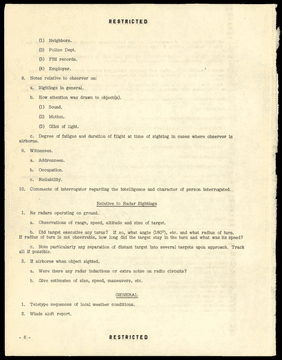
PAGE 116

form

This page is a continuation of a reporting form for unidentified aerial phenomena, listing specific data points to be recorded by observers, such as object characteristics, flight behavior, and environmental context.

RESTRICTED

b. Air
(1) Type aircraft, speed, altitude, direction of flight.
(2) Distance and direction from city, town or known landmark.
(3) Clock position of object from observer's aircraft.
(4) Latitude and longitude.
c. Sea
(1) Latitude and longitude.
(2) Proximity to land. (Name city, country, etc.)
4. Number of objects.
Formation type (if any), sketch if possible.
5. Observable celestial phenomena or planets that may account for the sighting. (Local facilities or organizations which follow such celestial phenomena should be consulted for such information.)
6. Distance of object from observer.
a. Laterally or horizontally.
b. Angle of elevation from horizon.
c. Altitude.
7. Time in sight.
8. Appearance of object.
a. Color.
b. Shape. (Sketch if possible)
c. Apparent construction. (Of what material or substance)
d. Size.
(1) Estimated size.
(2) Size as it appeared from observer's view. (Compared to known object)
9. Direction of flight.
10. Tactics or maneuvers.
Vertical ascent or descent, horizontal, oscillating, fluttering, evasive, aggressive, erratic, etc.
11. Evidence of exhaust.
a. Color of smoke.
b. Length and width.

RESTRICTED - 3 -

PAGE 117

report

This page is a continuation of a questionnaire or checklist used for reporting unidentified aerial phenomena, specifically detailing characteristics like cloud effects, lights, support mechanisms, propulsion, and control/stability.

RESTRICTED

c. Odor (if any).
d. Rate of evaporation.
e. Does trail vary with sound? (spurts)
12. Effect on clouds.
a. Opened path thru clouds.
b. Forced cloud or mists.
c. Reflected on cloud.
d. Showed thru cloud.
13. Lights.
a. Reflected or attached.
b. Luminous
c. Blinked on and off in relation to speed.
14. Support
a. Wings.
b. Aerodynamic list of fuselage.
c. Vertical jet.
d. Rotating cylinder or cone.
e. Aerostatic lift (balloon or dirigible).
15. Propulsion.
a. Propeller or jet.
b. Rotor.
c. Aerodynamic vanes (flapping or oscillating) (Katz Mayer effect).
d. Visible exhaust or jet openings.
16. Control and stability.
a. Fins
b. Stabilizers (horizontal or vertical).
(1) Size.
(2) Shape.
(3) Location.

- 4 - RESTRICTED

PAGE 118

form

This page is a continuation of a questionnaire or reporting form, listing criteria for describing UAP characteristics (air ducts, speed, sound, disappearance) and observer background information.

RESTRICTED

17. Air ducts.
a. Slots.
b. Duct openings.
18. Speed - M.P.H.
19. Sound.
a. Continuous whine or buzz.
b. Roar, whistle, whoosh.
c. Intermittent.
20. Manner of disappearance.
a. Explode.
(1) Possibility of fragments.
(2) Other physical evidence.
b. Faded from view.
c. Disappeared behind obstacle.

Relative to the Observer

1. Name of observer.
2. Address.
3. Occupation.
4. Place of business.
a. Employer or employee.
5. Pertinent hobbies.
a. Is observer amateur astronomer, pilot, engineer, etc.
b. Length of time engaged in hobby (experience).
6. Ability to determine:
a. Color.
b. Speed of moving objects.
c. Size at distance.
7. Reliability of observer.
a. Sources.

RESTRICTED - 5 -

PAGE 119

form

This page is a continuation of a questionnaire or reporting form regarding UFO/UAP sightings, specifically detailing sections for observer notes, witness information, radar sighting data, and general meteorological data.

RESTRICTED

(1) Neighbors.
(2) Police Dept.
(3) FBI records.
(4) Employer.
8. Notes relative to observer on:
a. Sightings in general.
b. How attention was drawn to object(s).
(1) Sound.
(2) Motion.
(3) Glint of light.
c. Degree of fatigue and duration of flight at time of sighting in cases where observer is airborne.
9. Witnesses.
a. Addressees.
b. Occupation.
c. Reliability.
10. Comments of interrogator regarding the intelligence and character of person interrogated.

Relative to Radar Sightings

1. Re radars operating on ground.
a. Observations of range, speed, altitude and size of target.
b. Did target executive any turns? If so, what angle (180°), etc. and what radius of turn. If radius of turn is not observable, how long did the target stay in the turn and what was its speed?
c. Note particularly any separation of distant target into several targets upon approach. Track all if possible.
2. If airborne when object sighted.
a. Were there any radar inductions or extra noise on radio circuits?
b. Give estimates of size, speed, maneuvers, etc.

GENERAL

1. Teletype sequences of local weather conditions.
2. Winds aloft report.

- 6 - RESTRICTED

PAGE 120

memo

This page outlines specific investigative procedures for reporting unidentified aerial objects, including checking flight schedules, testing for radioactivity, and collecting physical evidence, signed by Major General C. P. Cabell.

RESTRICTED

3. Local flight schedules of commercial, private and military aircraft flying in vicinity at the time. (Check Canadian activity if close to that border.)

4. Possible releases of testing devices in vicinity sent aloft by Ordnance, Navy, Air Force, Army, Weather Units, Research Organizations or any other.

5. If object contacted earth, obtain soil samples within and without depression or spot where object landed (and then presumably departed) for purpose of making comparison of soils.

6. If object came sufficiently near other aircraft or known objects check surfaces with Geiger counters for possible radioactivity. Make comparisons with other unaffected aircraft objects, etc.

7. Obtain photographs (or original negatives) where available; if not, secure sketches of:

a. Object.

b. Surrounding terrain where observed.

c. Place where it contacted earth (if this happened).

d. Maneuvers.

e. Formation if objects were more than two.

8. Secure signed statement.

9. Obtain fragments or physical evidence where possible.

10. Was any radio antenna to be observed, i.e., (any projections or extentions that might presumably be construed as such).

[HANDWRITTEN: C. P. Cabell]
C. P. CABELL
Major General, USAF
Director of Intelligence, Office of
Deputy Chief of Staff, Operations

DISTRIBUTION:

Commanding Generals, Major Air Commands,
ZI and Overseas
All United States Air Attaches

Director of Central Intelligence
Special Assistant for Research and Intelligence,
Department of State
Director of Intelligence, GSUSA
Chief of Naval Intelligence
Commandant (INT), United States Coast Guard
Director, Federal Bureau of Investigation

RESTRICTED
- 7 -

PAGE 121

PAGE 122

memo

This is Air Intelligence Requirements Memorandum Number 4, dated February 15, 1949, which outlines procedures for reporting sightings of unconventional aircraft and unidentified flying objects (UFOs) to the Air Force.

RESTRICTED

DEPARTMENT OF THE AIR FORCE
HEADQUARTERS UNITED STATES AIR FORCE
DIRECTORATE OF INTELLIGENCE
WASHINGTON 25, D. C.

15 February 1949

AIR INTELLIGENCE REQUIREMENTS
MEMORANDUM NUMBER 4

UNCONVENTIONAL AIRCRAFT

PART I - GENERAL

1. PURPOSE

The purpose of this memorandum is twofold:

a. To enunciate continuing Air Force requirements for information pertaining to sightings of unconventional aircraft and unidentified flying objects, including the so-called "Flying Discs."

b. To establish procedures for reporting such information.

2. RESCISSION

Department of the Army Collection Memorandum Number 7, dated 21 January 1948, and letter, CSGID 425.1, dated 25 March 1948, both subject as above, which have been transferred to Air Force agencies for action, are herewith superseded.

3. REPORTING

a. General

(1) As complete an answer to the requirements enunciated in Part II, as may be procurable, should be dispatched by means of electrical transmission immediately after sightings.

(2) Supplementary reports should be forwarded as available by the most expeditious means consistent with the importance of the information reported.

b. Major Air Commands (Overseas) and Air Attaches

(1) Initial and supplementary cabled reports will be transmitted to the Director of Intelligence, Headquarters United States Air Force. Cables will contain the phase, "Pass to COMGENAMC WRIGHT-PATTERSON AFB, DAYTON, OHIO, ATTN: MCIAXO-3."

RESTRICTED
[HANDWRITTEN: 65-83894-164] C9-4892,AF

PAGE 123

report

This page outlines reporting procedures for UAP sightings, specifying that reports should be sent to the Air Materiel Command at Wright-Patterson Air Force Base using AF Form 112, and lists the required information for such reports.

RESTRICTED

(2) Supplementary written reports, prepared on AF Form 112, will be forwarded to the Director of Intelligence, Headquarters United States Air Force.

(3) Commanding General, Air Materiel Command is authorized direct contact with major Air Commands (overseas) and organizations under their control in connection with the development of information on this subject.

c. Major Air Commands (ZI)

(1) Reports will be forwarded direct to the Commanding General, Air Materiel Command, Wright-Patterson Air Force Base, Dayton, Ohio, Attn: MCIAXO-3 by installations receiving information pertaining to the requirements enunciated in Part II.

(2) Copies of such reports may be supplied the Command Headquarters of the installation concerned.

(3) A copy of all reports sent to Air Materiel Command in accordance with these instructions will be forwarded at the same time to the Director of Intelligence, Headquarters United States Air Force.

(4) Written reports will be submitted on AF Form 112.

(5) Commanding General, Air Materiel Command is authorized direct contact with major Air Commands (ZI) and organizations under their control in connection with the development of information on this subject.

d. Non-Air Force Agencies

(1) Addressees other than those of the United States Air Force are requested to forward reports direct to the Commanding General, Air Materiel Command, Wright-Patterson Air Force Base, Dayton, Ohio, Attn: MCIAXO-3.

(2) In order to reduce the time factor involved in transmission of this type of information it is requested that, wherever communications facilities permit, subordinate elements be authorized to communicate reports direct to the Commanding General, Air Materiel Command.

PART II - REQUIREMENTS

General

1. Date of sighting.

2. Time of sighting (zonal by 24 hr. clock).

3. Where sighted (observer's position):

a. Ground

(1) City, town.

(2) Distance and direction from city or town, road, intersection, etc.

(3) From building (story), yard, etc.

(4) Map coordinates (if feasible) showing latitude and longitude.

- 2 - RESTRICTED
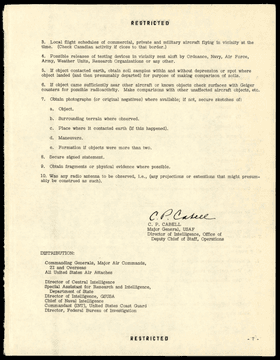
PAGE 124

report

This page is a continuation of a reporting form, listing specific criteria for documenting sightings of aerial or sea-based objects, including physical characteristics, maneuvers, and environmental context.

RESTRICTED

b. Air
(1) Type aircraft, speed, altitude, direction of flight.
(2) Distance and direction from city, town or known landmark.
(3) Clock position of object from observer's aircraft.
(4) Latitude and longitude.
c. Sea
(1) Latitude and longitude.
(2) Proximity to land. (Name city, country, etc.)
4. Number of objects.
Formation type (if any), sketch if possible.
5. Observable celestial phenomena or planets that may account for the sighting. (Local facilities or organizations which follow such celestial phenomena should be consulted for such information.)
6. Distance of object from observer.
a. Laterally or horizontally.
b. Angle of elevation from horizon.
c. Altitude.
7. Time in sight.
8. Appearance of object.
a. Color.
b. Shape. (Sketch if possible)
c. Apparent construction. (Of what material or substance)
d. Size.
(1) Estimated size.
(2) Size as it appeared from observer's view. (Compared to known object)
9. Direction of flight.
10. Tactics or maneuvers.
Vertical ascent or descent, horizontal, oscillating, fluttering, evasive, aggressive, erratic, etc.
11. Evidence of exhaust.
a. Color of smoke.
b. Length and width.

RESTRICTED - 3 -

PAGE 125

report

This page is a continuation of a technical questionnaire or observation guide for reporting unidentified aerial phenomena, specifically detailing categories for cloud effects, lights, support mechanisms, propulsion, and control/stability.

RESTRICTED

c. Odor (if any).
d. Rate of evaporation.
e. Does trail vary with sound? (spurts)
12. Effect on clouds.
a. Opened path thru clouds.
b. Forced cloud or mists.
c. Reflected on cloud.
d. Showed thru cloud.
13. Lights.
a. Reflected or attached.
b. Luminous
c. Blinked on and off in relation to speed.
14. Support
a. Wings.
b. Aerodynamic list of fuselage.
c. Vertical jet.
d. Rotating cylinder or cone.
e. Aerostatic lift (balloon or dirigible).
15. Propulsion.
a. Propeller or jet.
b. Rotor.
c. Aerodynamic vanes (flapping or oscillating) (Katz Mayer effect).
d. Visible exhaust or jet openings.
16. Control and stability.
a. Fins
b. Stabilizers (horizontal or vertical).
(1) Size.
(2) Shape.
(3) Location.
- 4 - RESTRICTED

PAGE 126

form

This page is a continuation of a questionnaire or reporting form, listing criteria for describing observed objects and the observer's background.

RESTRICTED

17. Air ducts.
   a. Slots.
   b. Duct openings.
18. Speed - M.P.H.
19. Sound.
   a. Continuous whine or buzz.
   b. Roar, whistle, whoosh.
   c. Intermittent.
20. Manner of disappearance.
   a. Explode.
      (1) Possibility of fragments.
      (2) Other physical evidence.
   b. Faded from view.
   c. Disappeared behind obstacle.

Relative to the Observer

1. Name of observer.
2. Address.
3. Occupation.
4. Place of business.
   a. Employer or employee.
5. Pertinent hobbies.
   a. Is observer amateur astronomer, pilot, engineer, etc.
   b. Length of time engaged in hobby (experience).
6. Ability to determine:
   a. Color.
   b. Speed of moving objects.
   c. Size at distance.
7. Reliability of observer.
   a. Sources.

RESTRICTED
- 5 -

PAGE 127

form

This page is a continuation of a questionnaire or reporting form, outlining specific criteria for documenting UFO/UAP sightings, including observer details, witness reliability, radar observations, and general meteorological data.

RESTRICTED

(1) Neighbors.
(2) Police Dept.
(3) FBI records.
(4) Employer.
8. Notes relative to observer on:
a. Sightings in general.
b. How attention was drawn to object(s).
(1) Sound.
(2) Motion.
(3) Glint of light.
c. Degree of fatigue and duration of flight at time of sighting in cases where observer is
airborne.
9. Witnesses.
a. Addressees.
b. Occupation.
c. Reliability.
10. Comments of interrogator regarding the intelligence and character of person interrogated.

Relative to Radar Sightings

1. Re radars operating on ground.
a. Observations of range, speed, altitude and size of target.
b. Did target executive any turns? If so, what angle (180°), etc. and what radius of turn.
If radius of turn is not observable, how long did the target stay in the turn and what was its speed?
c. Note particularly any separation of distant target into several targets upon approach. Track
all if possible.
2. If airborne when object sighted.
a. Were there any radar inductions or extra noise on radio circuits?
b. Give estimates of size, speed, maneuvers, etc.

GENERAL

1. Teletype sequences of local weather conditions.
2. Winds aloft report.

- 6 - RESTRICTED

PAGE 128

memo

This page is a continuation of a directive outlining procedures for investigating unidentified aerial objects, including instructions for collecting soil samples, checking for radioactivity, obtaining photographic evidence, and securing statements.

RESTRICTED

3. Local flight schedules of commercial, private and military aircraft flying in vicinity at the time. (Check Canadian activity if close to that border.)

4. Possible releases of testing devices in vicinity sent aloft by Ordnance, Navy, Air Force, Army, Weather Units, Research Organizations or any other.

5. If object contacted earth, obtain soil samples within and without depression or spot where object landed (and then presumably departed) for purpose of making comparison of soils.

6. If object came sufficiently near other aircraft or known objects check surfaces with Geiger counters for possible radioactivity. Make comparisons with other unaffected aircraft objects, etc.

7. Obtain photographs (or original negatives) where available; if not, secure sketches of:

a. Object.

b. Surrounding terrain where observed.

c. Place where it contacted earth (if this happened).

d. Maneuvers.

e. Formation if objects were more than two.

8. Secure signed statement.

9. Obtain fragments or physical evidence where possible.

10. Was any radio antenna to be observed, i.e., (any projections or extentions that might presumably be construed as such).

C. P. CABELL
C. P. CABELL
Major General, USAF
Director of Intelligence, Office of
Deputy Chief of Staff, Operations

DISTRIBUTION:

Commanding Generals, Major Air Commands,
ZI and Overseas
All United States Air Attaches

Director of Central Intelligence
Special Assistant for Research and Intelligence,
Department of State
Director of Intelligence, GSUSA
Chief of Naval Intelligence
Commandant (INT), United States Coast Guard
Director, Federal Bureau of Investigation

RESTRICTED
- 7 -

PAGE 129

PAGE 130

memo

This is Air Intelligence Requirements Memorandum Number 4, dated February 15, 1949, which outlines procedures for reporting sightings of unconventional aircraft and unidentified flying objects to the U.S. Air Force.

RESTRICTED

DEPARTMENT OF THE AIR FORCE
HEADQUARTERS UNITED STATES AIR FORCE
DIRECTORATE OF INTELLIGENCE
WASHINGTON 25, D. C.

15 February 1949

AIR INTELLIGENCE REQUIREMENTS
MEMORANDUM NUMBER 4

UNCONVENTIONAL AIRCRAFT

PART I - GENERAL

1. PURPOSE

The purpose of this memorandum is twofold:

a. To enunciate continuing Air Force requirements for information pertaining to sightings of unconventional aircraft and unidentified flying objects, including the so-called "Flying Discs."

b. To establish procedures for reporting such information.

2. RESCISSION

Department of the Army Collection Memorandum Number 7, dated 21 January 1948, and letter, CSGID 425.1, dated 25 March 1948, both subject as above, which have been transferred to Air Force agencies for action, are herewith superseded.

3. REPORTING

a. General

(1) As complete an answer to the requirements enunciated in Part II, as may be procurable, should be dispatched by means of electrical transmission immediately after sightings.

(2) Supplementary reports should be forwarded as available by the most expeditious means consistent with the importance of the information reported.

b. Major Air Commands (Overseas) and Air Attaches

(1) Initial and supplementary cabled reports will be transmitted to the Director of Intelligence, Headquarters United States Air Force. Cables will contain the phase, "Pass to COMGENAMC WRIGHT-PATTERSON AFB, DAYTON, OHIO, ATTN: MCIAXO-3."

RESTRICTED
[HANDWRITTEN: 65- 83894-164]

PAGE 131

memo

This page outlines the reporting procedures for Air Force and non-Air Force agencies regarding sightings, including where to send reports and the specific information required for the report (Part II).

RESTRICTED

(2) Supplementary written reports, prepared on AF Form 112, will be forwarded to the Director of Intelligence, Headquarters United States Air Force.

(3) Commanding General, Air Materiel Command is authorized direct contact with major Air Commands (overseas) and organizations under their control in connection with the development of information on this subject.

c. Major Air Commands (ZI)

(1) Reports will be forwarded direct to the Commanding General, Air Materiel Command, Wright-Patterson Air Force Base, Dayton, Ohio, Attn: MCIAXO-3 by installations receiving information pertaining to the requirements enunciated in Part II.

(2) Copies of such reports may be supplied the Command Headquarters of the installation concerned.

(3) A copy of all reports sent to Air Materiel Command in accordance with these instructions will be forwarded at the same time to the Director of Intelligence, Headquarters United States Air Force.

(4) Written reports will be submitted on AF Form 112.

(5) Commanding General, Air Materiel Command is authorized direct contact with major Air Commands (ZI) and organizations under their control in connection with the development of information on this subject.

d. Non-Air Force Agencies

(1) Addressees other than those of the United States Air Force are requested to forward reports direct to the Commanding General, Air Materiel Command, Wright-Patterson Air Force Base, Dayton, Ohio, Attn: MCIAXO-3.

(2) In order to reduce the time factor involved in transmission of this type of information it is requested that, wherever communications facilities permit, subordinate elements be authorized to communicate reports direct to the Commanding General, Air Materiel Command.

PART II - REQUIREMENTS

General

1. Date of sighting.
2. Time of sighting (zonal by 24 hr. clock).
3. Where sighted (observer's position):

a. Ground
(1) City, town.
(2) Distance and direction from city or town, road, intersection, etc.
(3) From building (story), yard, etc.
(4) Map coordinates (if feasible) showing latitude and longitude.

- 2 -
RESTRICTED
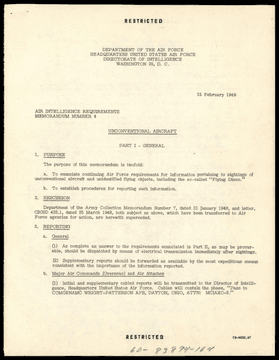
PAGE 132

report

This page is a continuation of a reporting form or manual, listing specific criteria for documenting aerial and maritime sightings, including physical characteristics, maneuvers, and environmental context.

RESTRICTED

b. Air
(1) Type aircraft, speed, altitude, direction of flight.
(2) Distance and direction from city, town or known landmark.
(3) Clock position of object from observer's aircraft.
(4) Latitude and longitude.
c. Sea
(1) Latitude and longitude.
(2) Proximity to land. (Name city, country, etc.)
4. Number of objects.
Formation type (if any), sketch if possible.
5. Observable celestial phenomena or planets that may account for the sighting. (Local facilities or organizations which follow such celestial phenomena should be consulted for such information.)
6. Distance of object from observer.
a. Laterally or horizontally.
b. Angle of elevation from horizon.
c. Altitude.
7. Time in sight.
8. Appearance of object.
a. Color.
b. Shape. (Sketch if possible)
c. Apparent construction. (Of what material or substance)
d. Size.
(1) Estimated size.
(2) Size as it appeared from observer's view. (Compared to known object)
9. Direction of flight.
10. Tactics or maneuvers.
Vertical ascent or descent, horizontal, oscillating, fluttering, evasive, aggressive, erratic, etc.
11. Evidence of exhaust.
a. Color of smoke.
b. Length and width.

RESTRICTED - 3 -

PAGE 133

report

This page is a continuation of a questionnaire or checklist for reporting unidentified aerial phenomena, specifically detailing characteristics like cloud effects, lights, support mechanisms, propulsion, and control/stability.

RESTRICTED

c. Odor (if any).
d. Rate of evaporation.
e. Does trail vary with sound? (spurts)
12. Effect on clouds.
a. Opened path thru clouds.
b. Forced cloud or mists.
c. Reflected on cloud.
d. Showed thru cloud.
13. Lights.
a. Reflected or attached.
b. Luminous.
c. Blinked on and off in relation to speed.
14. Support
a. Wings.
b. Aerodynamic list of fuselage.
c. Vertical jet.
d. Rotating cylinder or cone.
e. Aerostatic lift (balloon or dirigible).
15. Propulsion.
a. Propeller or jet.
b. Rotor.
c. Aerodynamic vanes (flapping or oscillating) (Katz Mayer effect).
d. Visible exhaust or jet openings.
16. Control and stability.
a. Fins
b. Stabilizers (horizontal or vertical).
(1) Size.
(2) Shape.
(3) Location.
- 4 - RESTRICTED
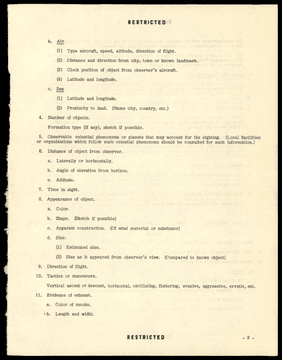
PAGE 134

form

This page is a continuation of a questionnaire or reporting form for UFO/UAP sightings, listing categories for physical characteristics of the object and observer background information.

RESTRICTED

17. Air ducts.
a. Slots.
b. Duct openings.
18. Speed - M.P.H.
19. Sound.
a. Continuous whine or buzz.
b. Roar, whistle, whoosh.
c. Intermittent.
20. Manner of disappearance.
a. Explode.
(1) Possibility of fragments.
(2) Other physical evidence.
b. Faded from view.
c. Disappeared behind obstacle.

Relative to the Observer

1. Name of observer.
2. Address.
3. Occupation.
4. Place of business.
a. Employer or employee.
5. Pertinent hobbies.
a. Is observer amateur astronomer, pilot, engineer, etc.
b. Length of time engaged in hobby (experience).
6. Ability to determine:
a. Color.
b. Speed of moving objects.
c. Size at distance.
7. Reliability of observer.
a. Sources.

RESTRICTED
- 5 -

PAGE 135

form

This page is a continuation of a questionnaire or reporting form, outlining specific categories of information to be collected regarding UFO/UAP sightings, including observer details, witness reliability, radar observations, and meteorological data.

RESTRICTED

(1) Neighbors.
(2) Police Dept.
(3) FBI records.
(4) Employer.
8. Notes relative to observer on:
a. Sightings in general.
b. How attention was drawn to object(s).
(1) Sound.
(2) Motion.
(3) Glint of light.
c. Degree of fatigue and duration of flight at time of sighting in cases where observer is airborne.
9. Witnesses.
a. Addressees.
b. Occupation.
c. Reliability.
10. Comments of interrogator regarding the intelligence and character of person interrogated.

Relative to Radar Sightings
1. Re radars operating on ground.
a. Observations of range, speed, altitude and size of target.
b. Did target executive any turns? If so, what angle (180°), etc. and what radius of turn. If radius of turn is not observable, how long did the target stay in the turn and what was its speed?
c. Note particularly any separation of distant target into several targets upon approach. Track all if possible.
2. If airborne when object sighted.
a. Were there any radar inductions or extra noise on radio circuits?
b. Give estimates of size, speed, maneuvers, etc.

GENERAL
1. Teletype sequences of local weather conditions.
2. Winds aloft report.

- 6 - RESTRICTED
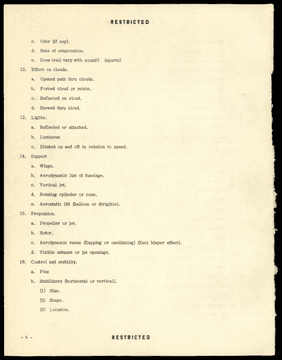
PAGE 136

memo

This page outlines specific investigative procedures for reporting unidentified aerial phenomena, including checking flight schedules, testing for radioactivity, and collecting physical evidence.

RESTRICTED
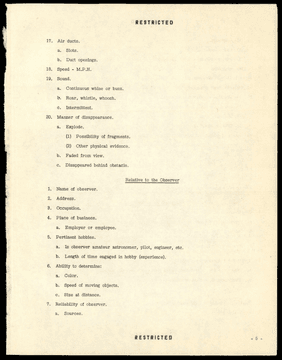
3. Local flight schedules of commercial, private and military aircraft flying in vicinity at the time. (Check Canadian activity if close to that border.)

4. Possible releases of testing devices in vicinity sent aloft by Ordnance, Navy, Air Force, Army, Weather Units, Research Organizations or any other.

5. If object contacted earth, obtain soil samples within and without depression or spot where object landed (and then presumably departed) for purpose of making comparison of soils.

6. If object came sufficiently near other aircraft or known objects check surfaces with Geiger counters for possible radioactivity. Make comparisons with other unaffected aircraft objects, etc.

7. Obtain photographs (or original negatives) where available; if not, secure sketches of:

a. Object.

b. Surrounding terrain where observed.

c. Place where it contacted earth (if this happened).

d. Maneuvers.

e. Formation if objects were more than two.

8. Secure signed statement.

9. Obtain fragments or physical evidence where possible.

10. Was any radio antenna to be observed, i.e., (any projections or extentions that might presumably be construed as such).

[HANDWRITTEN: C. P. Cabell]
C. P. CABELL
Major General, USAF
Director of Intelligence, Office of
Deputy Chief of Staff, Operations

DISTRIBUTION:

Commanding Generals, Major Air Commands,
ZI and Overseas
All United States Air Attaches

Director of Central Intelligence
Special Assistant for Research and Intelligence,
Department of State
Director of Intelligence, GSUSA
Chief of Naval Intelligence
Commandant (INT), United States Coast Guard
Director, Federal Bureau of Investigation

RESTRICTED
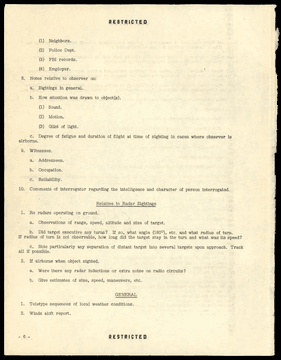
- 7 -

PAGE 137

blank

This is a blank page with the word RESTRICTED printed at the top and bottom.
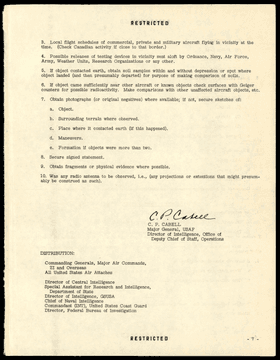
RESTRICTED
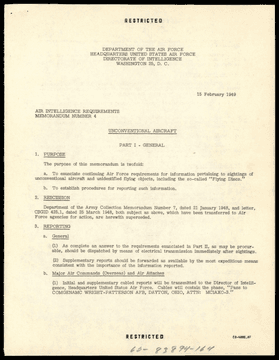
RESTRICTED